

In Between Takes you play the star of a 1940s noir film who is also its director. While the camera rolls, the danger is real. Call CUT and the film freezes: colour comes back, and the city turns out to be plywood, cables and winches on a soundstage. You walk the frozen set, change the machinery, go back to your mark and call ACTION. The scene continues from the same frame, and plays out the way you rigged it.
The game was built the same way it plays. One person directs. AI agents run most of the machinery: they write the code, run the builds, test, and write reports. The person decides what goes in, what comes out, and whether the take is good enough to print.
This log tells that story as it happened, with the receipts.
How to read this log#
- Who did what. Each section separates what the developer decided, what an AI agent proposed or produced, and what was checked, and how.
- What "works" means. A named test, run on a named build, with a result we can show. Two kinds are kept apart: verified automatically (the game checked its own rules, with no one playing) and validated by a person (someone actually played it). Anything else is called untested.
- Times are Brasília local time (UTC−3), taken from commit timestamps, file metadata and the game's own logs.
- Pictures. Every screenshot in this log was saved by the game itself during an automated run. None are mock-ups or concept art.
Introduction — The Vision#
A theme that is a verb#
"Director's Cut" could have been a game about a film. We wanted it to be something the player does. The question behind the design: what if stopping the film were the main mechanic?
One mechanic, three rules#
- The film is a formula. Every moving thing in the movie — a falling sign, a car on rails — is driven by a single scene clock. Freeze the clock and the film is frozen exactly. Ask the formula where the sign will end up, and you can draw that on the floor before it happens.
- Only the future changes. If the sign has already fallen past three metres, no winch can catch it at three metres. When you cut matters as much as what you change.
- Back to one. While you walk the set as the director, a frozen stand-in holds your place in the shot. On ACTION you go back into it, with the speed you had. You cannot walk around the danger. You have to redirect it.
What we were worried about#
That this would turn into a lock-and-key puzzle with a pretty transition: press CUT, click the only lever, press ACTION, done. That worry is still open. The developer's first playtests found the solutions "relatively easy", which is a warning sign worth taking seriously — see Is it fun?
The plan#
One street, one soundstage, three scenes: a falling sign, a runaway car on rails, and a building front that drops on the hero. Scene 1 is the tutorial.
Day 1 — Making the Cut#
Thursday, 12 November
An hour of paper before a line of code#
The first session produced no game. The developer gave the planning brief to an AI agent (Claude, running in Claude Code) acting as lead designer and architect. They asked for a production foundation: design document, technical design, art and audio direction, a four-day roadmap, a risk register, and an operating manual for several agents working in parallel.
The agent started by checking, not assuming:
- The machine. Unreal 5.8.4, Visual Studio 2026, Git LFS, Blender — and an AMD graphics card. That ruled out the NVIDIA prize, which requires NVIDIA rendering features.
- The rules, all 16 pages. Two findings changed the plan straight away. A submission may not feature trademarks, logos included, apart from the Unreal Engine logo; whether our own studio logo would count wasn't worth the risk, so it stays out of the game and the video. And the entry must be submitted by a person, not by an agent. Everything in the game and the video must also be in English.
- The engine. The documentation for Unreal's built-in AI connection (Unreal MCP) is written for version 5.9 and says the plugin is on by default. The agent opened the plugin files on disk and found it ships switched off in 5.8.4.
Then it argued with the concept. The proposals that shaped everything after:
| The agent proposed | Because |
|---|---|
| In CUT you walk the set with your own body, and go back to your mark on ACTION | Clicking on levers with a cursor would make it a menu. Letting you stay where you walked would let you skip the danger |
| No physics simulation for film events — everything follows the scene clock | Exact freeze, exact preview of the outcome, trivial restart |
| The "chase" is a car on a rail, not an AI enemy | Predictable, cheap, and a rail car is film equipment |
| The finale is a building front falling with the hero standing in the window | One image that explains the game in a second |
| Two kinds of rig, not three | The third variable, timing, is already in every scene: it's the moment you cut |
The developer's call (about 11:05): approve all of it, and add ten instructions of their own. Among them: check the compiler before writing any system; set up version control before the core; test the gameplay as soon as one loop works; and don't move to the next scene while the core isn't good.
Does it even compile?#
The developer's first instruction was blunt: find out now whether Unreal 5.8.4 and the installed C++ compiler work together, and fall back to visual scripting (Blueprints) if they don't. Visual Studio 2026 is newer than the compiler Unreal 5.8 was tested with.
The agent read the engine's own list of preferred and banned compiler versions, wrote a minimal game module by hand rather than copying the template's code, and started the build.
It failed in 47 seconds, and not because of the compiler:
Unable to build while Live Coding is active.
No editor was open on this project. The developer had another Unreal project open as a warm-up exercise. Every editor shares the same engine program, so the build tool refused to touch anything. The agent didn't close the developer's editor. It read the build tool's source code to see exactly what the check protects, found the switch that skips it, and confirmed it was safe here: only this project's files would be written.
Second attempt: compiled and linked in 75 seconds (commit 023483a, 11:17). The compiler worry was gone a few minutes after the go-ahead, and the Blueprint fallback was never needed.
The same warm-up editor blocked the packaging step later in the day, for the same reason, and got the same fix.
The first CUT, with nobody watching#
An AI agent can write a game, but it can't look at the window or hold a mouse. Two choices followed from that, and they shaped the whole morning.
1. Build the prototype entirely in code. No level file, no Blueprints, no input assets, no materials. The street is spawned from grey boxes when the game starts. The keys are bound in C++. The black-and-white film look is the camera's own post-processing. Everything is plain text that the agent can read, compare and compile.
2. Make the game play itself. A small "demo driver" plays Scene 1 through the same functions the keyboard calls. It logs PASS or FAIL, measures distances and timings, and tells the game to save screenshots at key moments. By midday it had eight scenarios.
The core compiled on the first try at 11:28: the director's state machine, the scene clock, the film and stage layers, the falling sign, the winch, the mark and the frozen stand-in, the on-screen text. Four automated tests passed at 11:29. At 11:30 the game ran for the first time, and the first scripted take reached the end of the scene.
How CUT works, in plain terms#
The film runs on its own clock, separate from the computer's. That clock only moves while the film is rolling.
The sign's height is not simulated. It is a formula: how far has it fallen, given how long ago it was released and where the cable will stop it? Pressing CUT stops the clock, so the sign stops exactly where it is. Nothing is paused in the engine; the actor can still walk around.
Because the outcome is a formula, the game can draw it before it happens. That is the white wire box in the screenshots: where the sign will hang when the film rolls again.
And because the formula knows where the sign is now, it can refuse any winch position the sign has already fallen past. That refusal is "only the future changes", and it is enforced by the set piece itself, not by the menu.
One of the four automated tests checks exactly this on real game objects. Halfway through the fall, with the clock frozen, it selects LOW and confirms the sign does not move by even a millimetre. Then it confirms HIGH is refused and the sign comes to rest at 30 cm when the clock runs on. (Test SetPiece.WinchAndSign, passing since 11:29.)
The first loop, frame by frame#
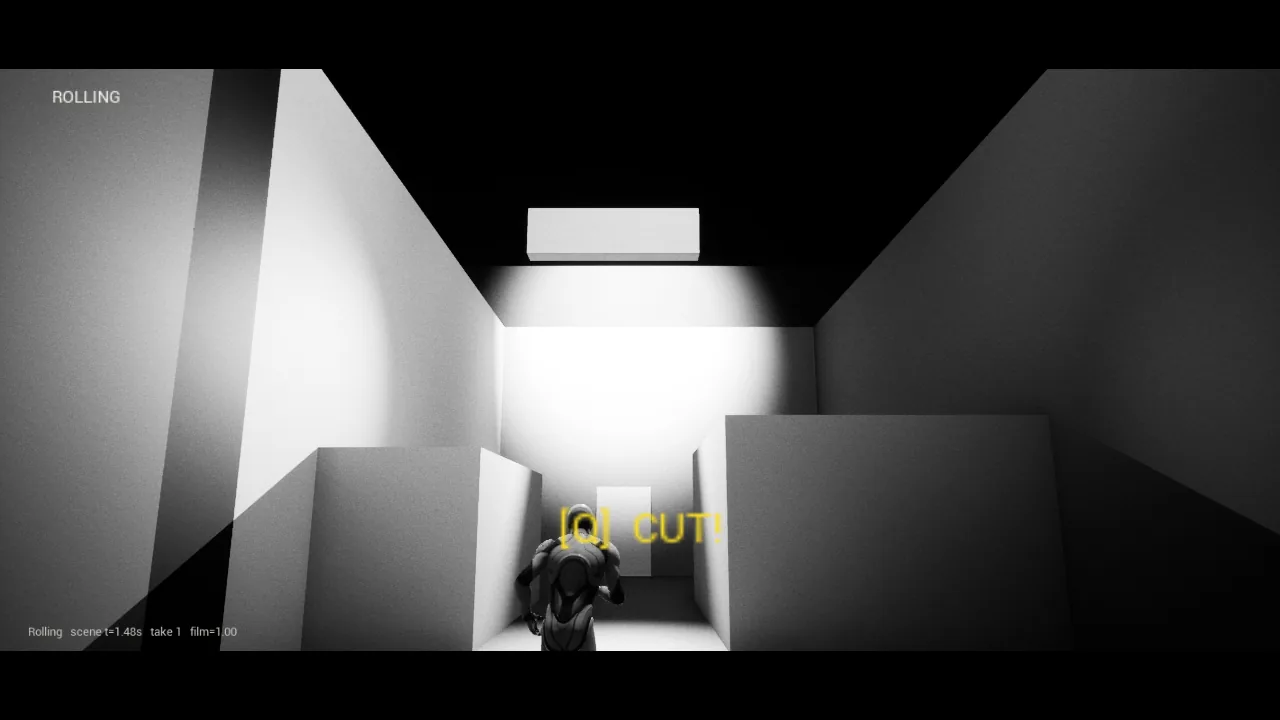 ACTION
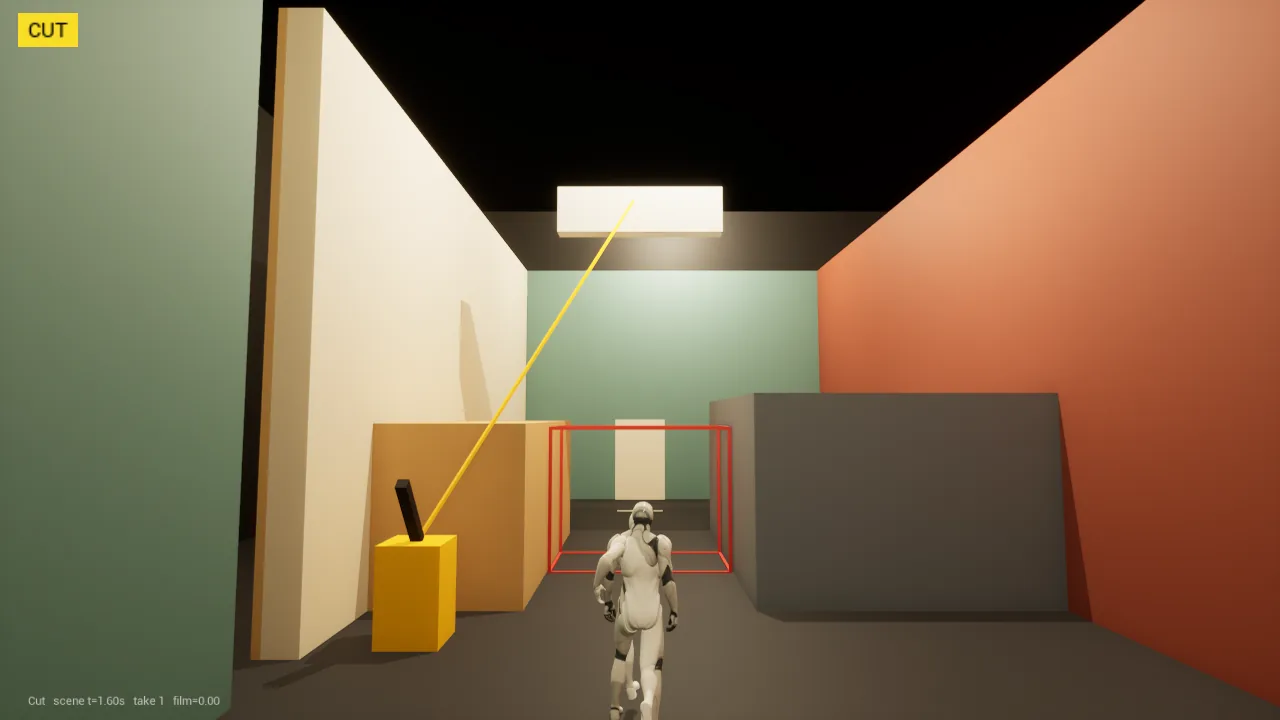 CUT
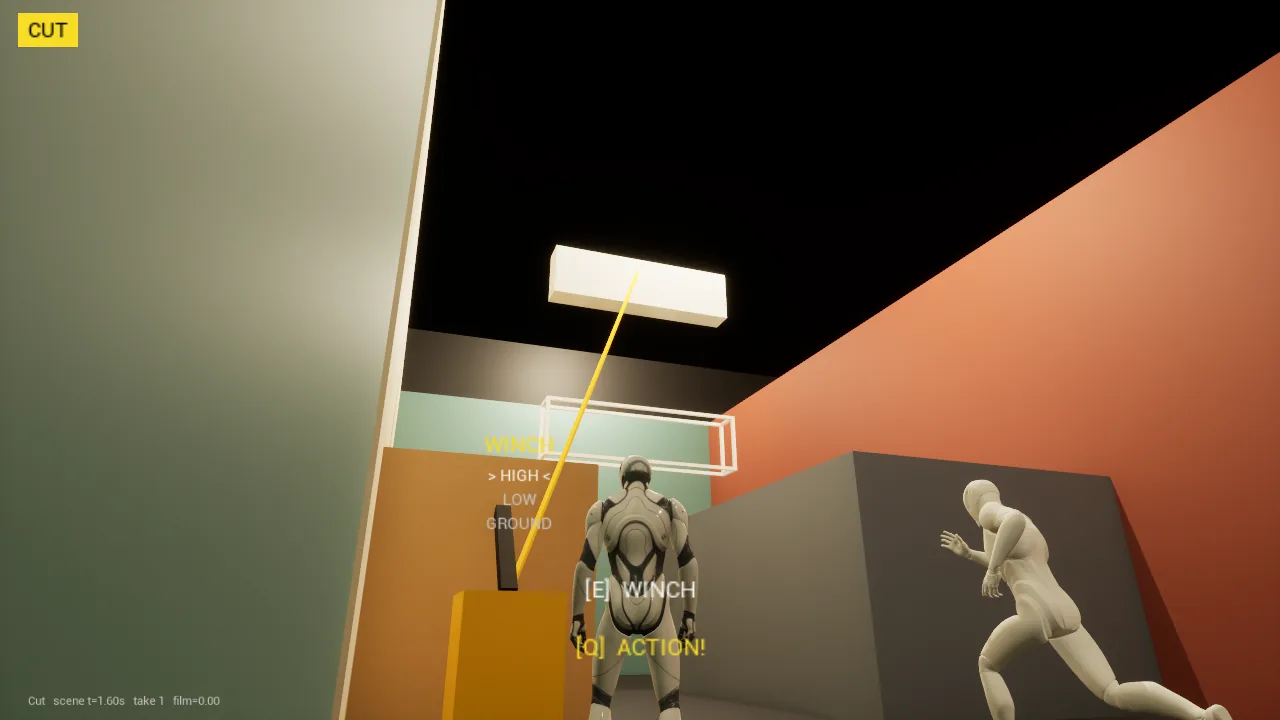 CUT
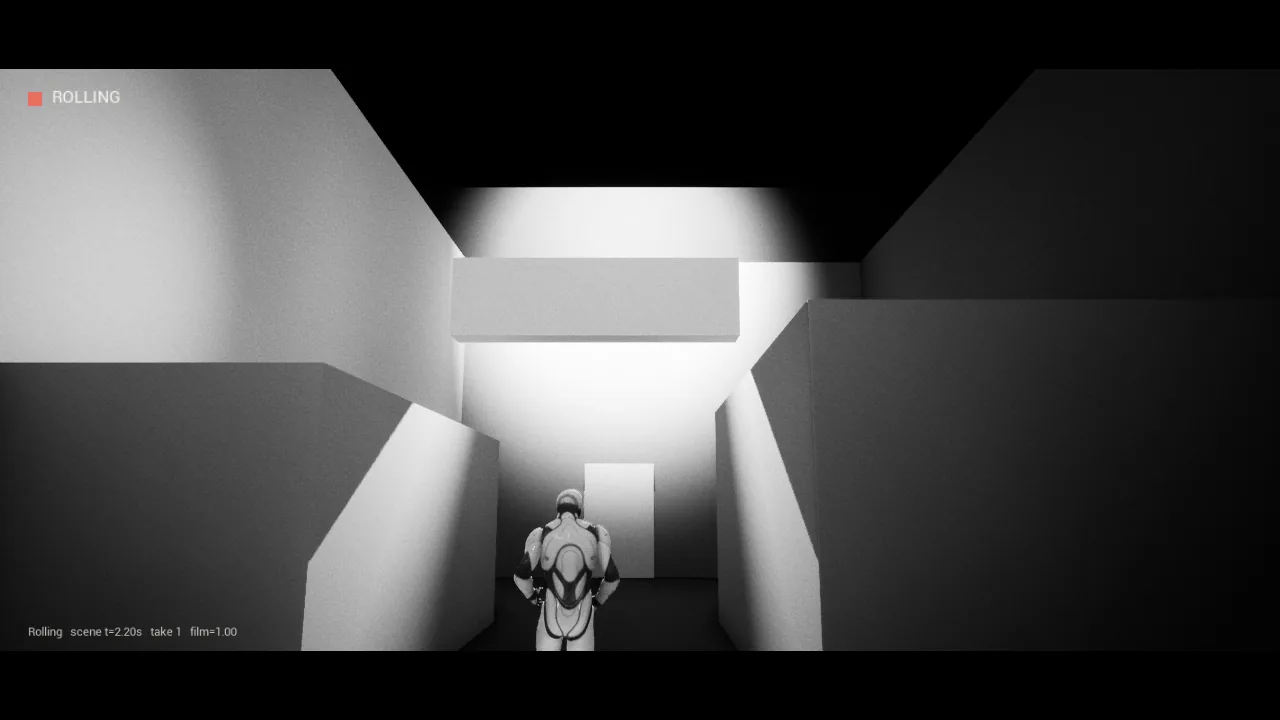 ACTION
Two settings, two different scenes#
The same sign, the same street, a different winch position:
| HIGH | LOW | |
|---|---|---|
| When you cut | Early — the sign is still near the top | Late — HIGH has already expired |
| Where it stops | 3.2 m up, swinging | 0.3 m up, intact, across the gap |
| What you do next | Run under it | Wait for the cable to catch it, then jump over |
| Scene finished at | 3.40 s of film time | 4.82 s of film time |
01ACTION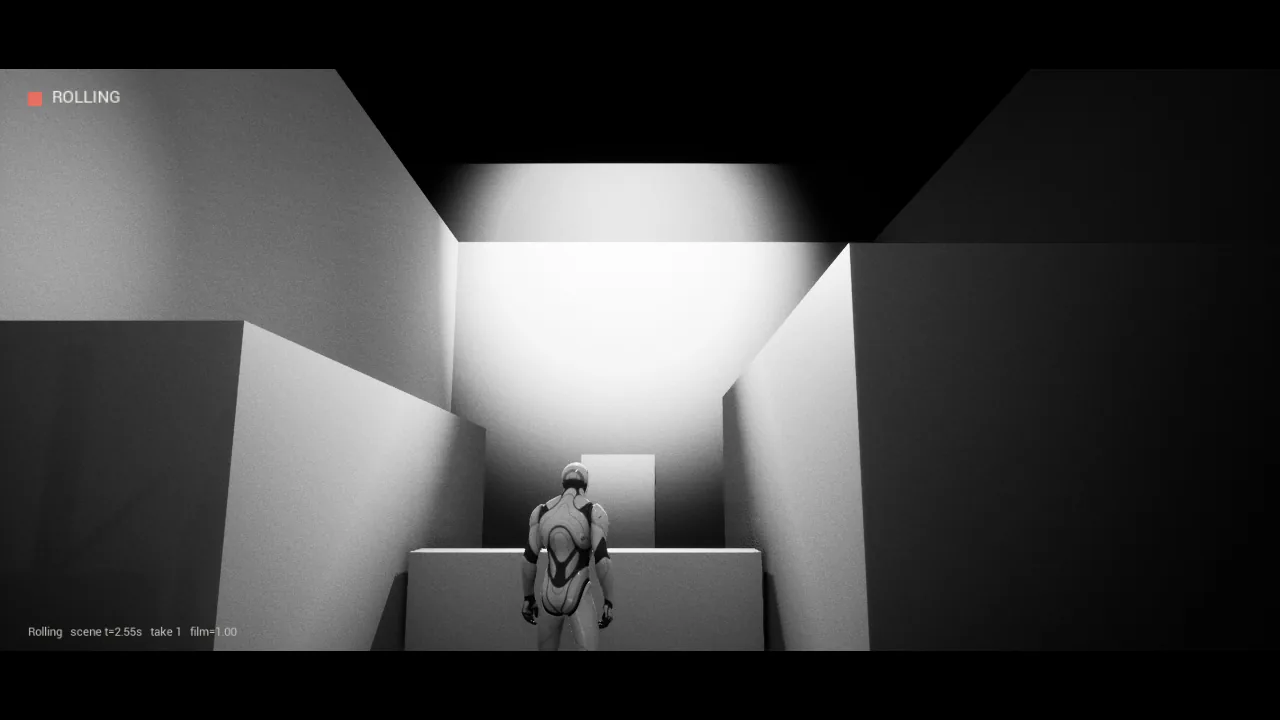 02ACTION
If you never cut, the sign hits you if you run, or blocks the street if you walk:
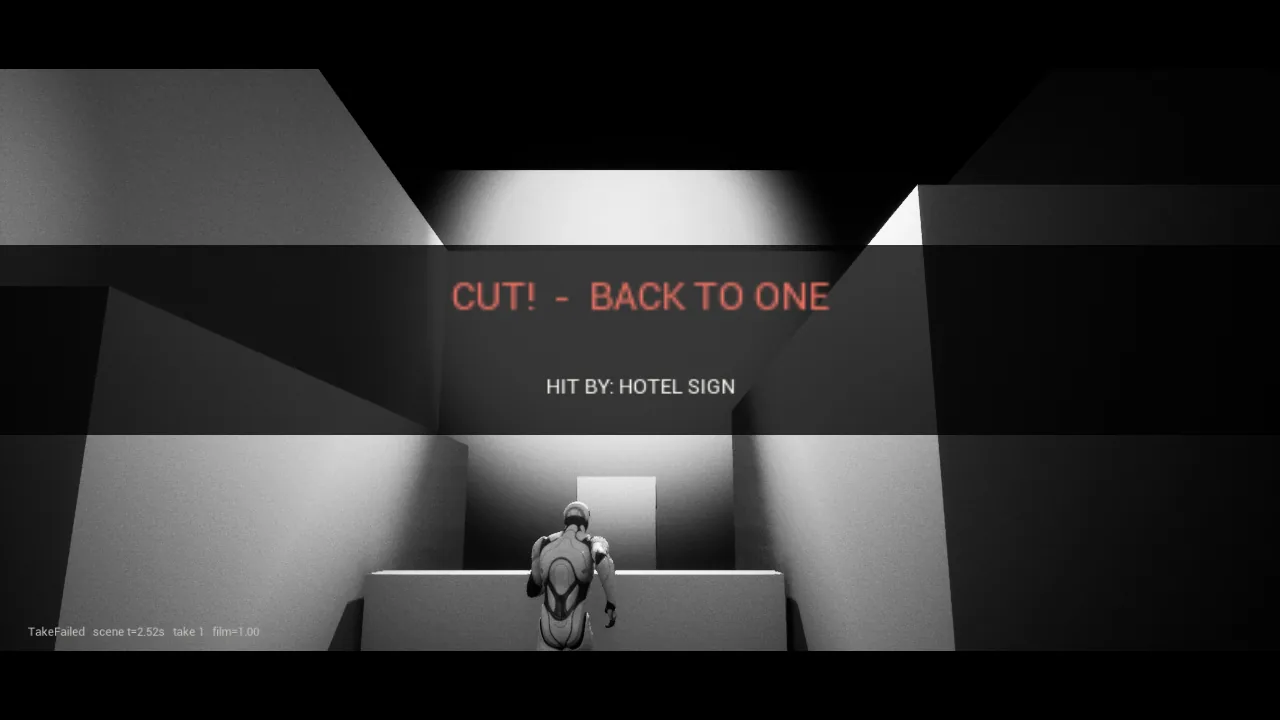
What the screenshots caught#
This is the part worth reading. The design looked fine on paper and the code compiled cleanly. Looking at what the game actually did found five problems no code review would have:
| What we saw | What was wrong | What changed (and who decided) |
|---|---|---|
| The first CUT screenshot showed the director cranking the winch while staring at a plywood wall | The winch stood behind the scenery. You could not see the sign, or its preview, while changing it. Cause and effect were off-screen | New rule: a rig always stands in sight of what it controls. The winch moved onto the street (agent; reversed in the afternoon, see 12:20) |
| In the ACTION screenshot there was no sign | Seven metres up, it sat above the letterboxed frame. The player would never see the danger | Sign lowered and lit from below; lower camera; the camera tilts up and pulls back while something is about to fall (agent; removed in the afternoon: the camera belongs to the player) |
| The "run straight, never cut" scenario never ended | The falling sign was solid, so it held the actor back before the hit test could see them touch. Running into it wasn't a hit | A falling object is a hazard, never a wall (agent) |
| The "cut late, catch it low" scenario died every time | With the paper numbers, anyone cutting late was already under the sign. "Cut late and you have fewer options" could never be survived, so it could never be learned | Slower fall, earlier trigger. There is now a window — about 0.18 s at full sprint (agent) |
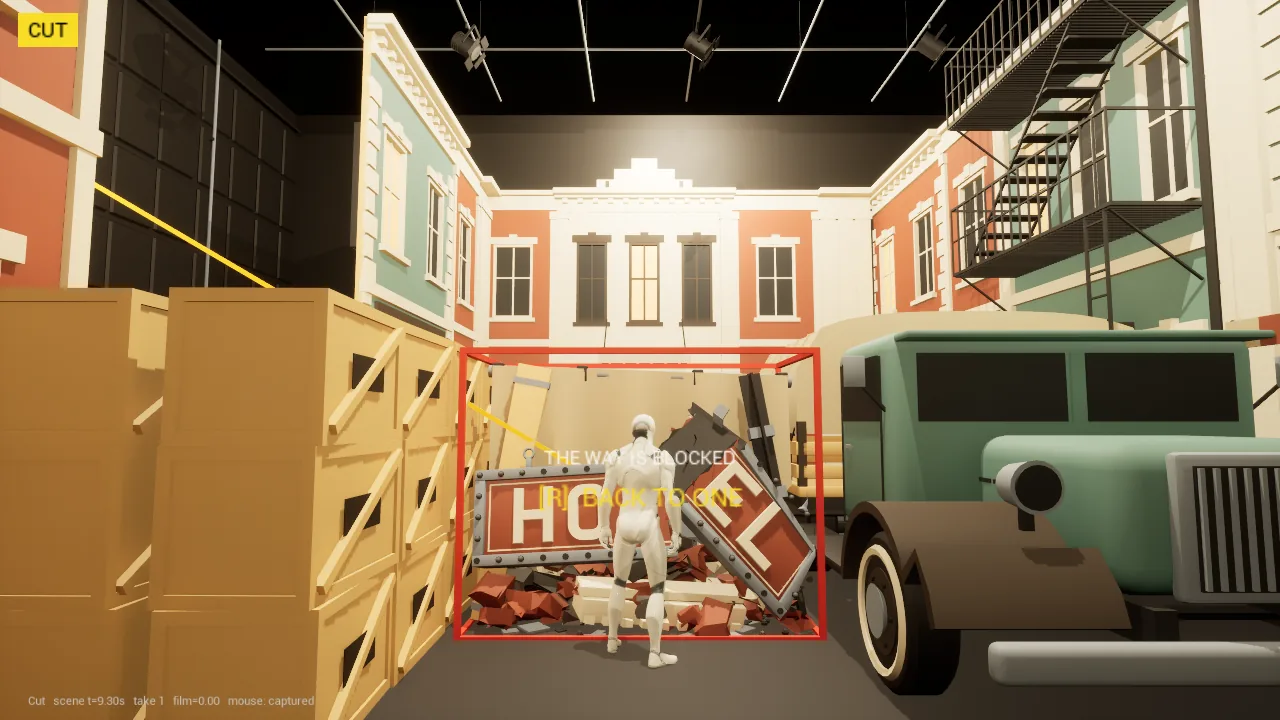
| Walking slowly, the actor ended up facing the wreck forever | A silent dead end | The screen says the way is blocked and offers "[R] BACK TO ONE" (agent) |
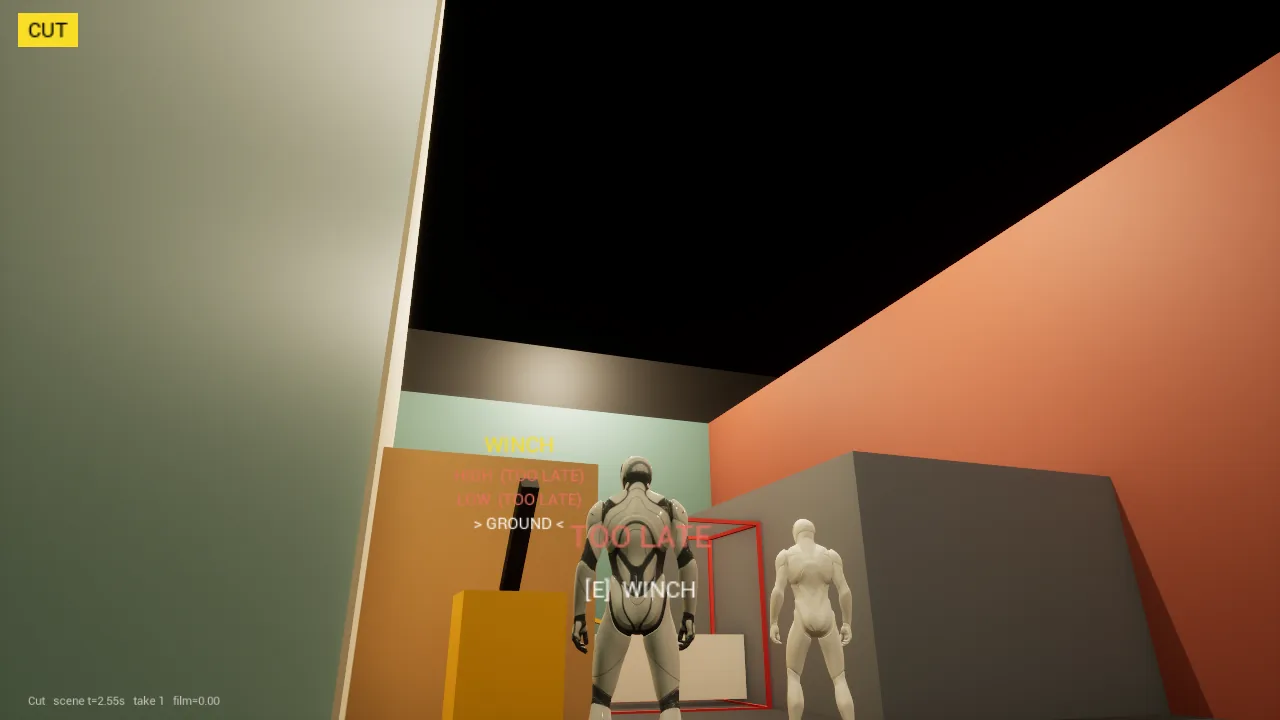 CUT
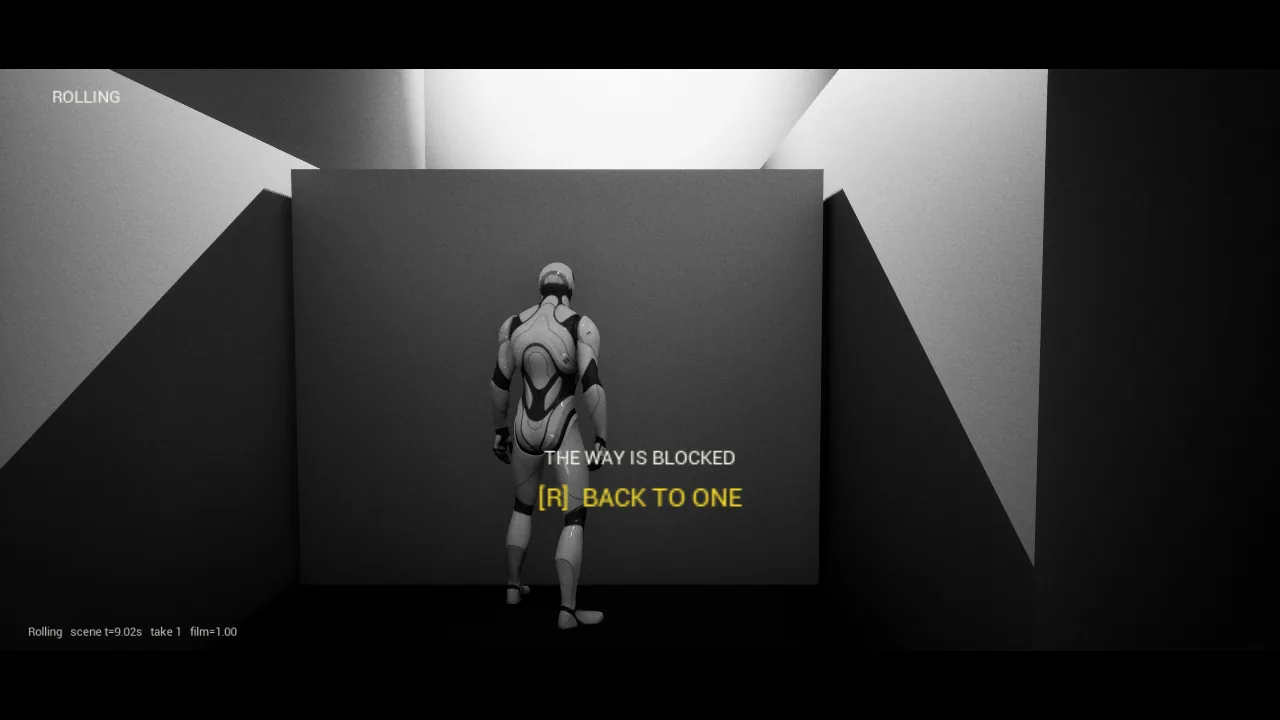
By 11:52 all seven scenarios passed. The run's log shows the actor returning to the mark with a measured error of 0.00 cm, and a cut in mid-jump that resumes still in the air.
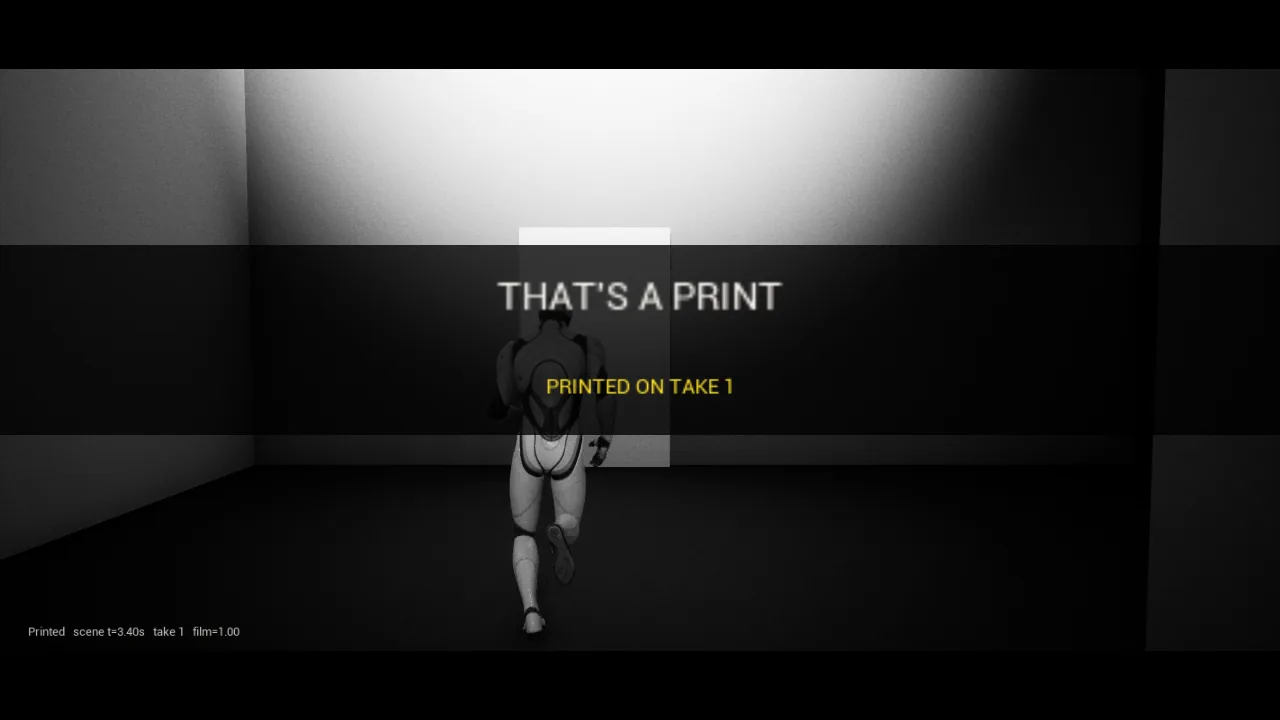
A build that runs without the editor#
At 12:00 the first Windows build was packaged: 566 assets processed, 658 MB unzipped. At 12:01 it ran outside the editor and finished the same scripted take.
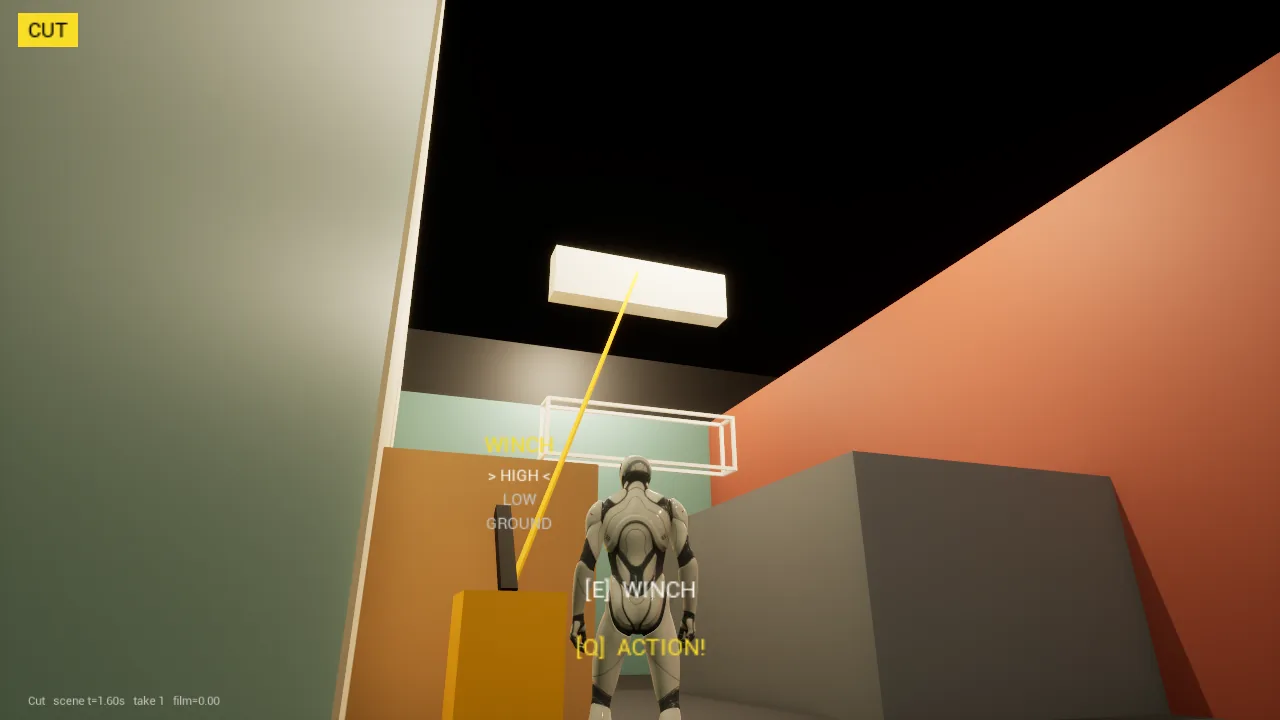 CUT
One more scenario then pressed real keys — Space, W, A, Q, E — through the game's input system, from the first step to the end mark. The point was to know the keyboard worked before a person sat down.
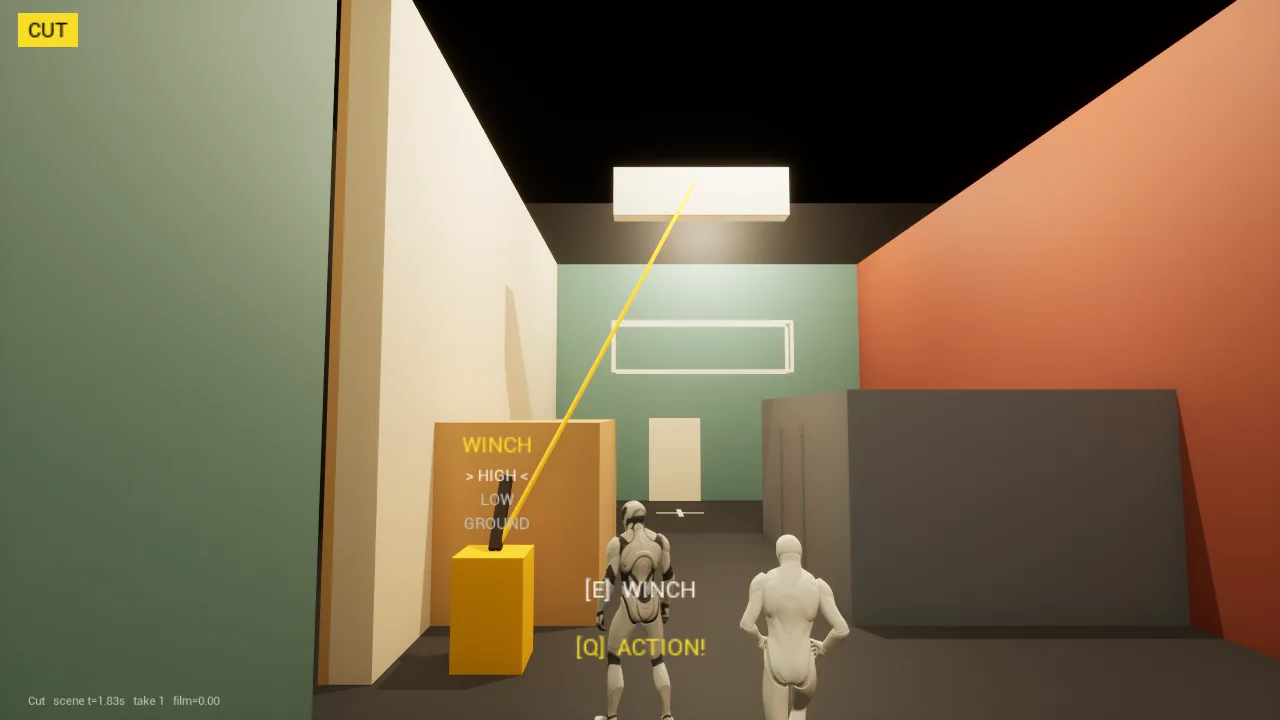 CUT
Two things from that build are still unexplained or unmeasured. The first launch took 51 seconds to draw its first 91 frames. And 658 MB is a lot for grey boxes; most of it is the engine.
Is it fun? Not yet known#
Everything above proves the rules work. None of it says whether the game feels good. A script running the rules is not a person playing.
The first human test didn't happen the way it was planned. The developer opened the Windows build over a remote-desktop connection, and the mouse cursor kept leaving the game window, which made the camera unusable. So the honest answer to "is it fun?" at this point in Day 1 is: we don't know yet. That question needs a person with a working mouse.
The agent grades its own homework#
Before any human had played, the agent reported what it thought was wrong with the design, from the numbers alone:
- HIGH always beats LOW. LOW only exists as a consolation for a late cut. That makes Scene 1 a puzzle with one right answer — exactly the lock-and-key risk we were worried about.
- There's no reason to cut late. Cutting early is always better, so the "when you cut matters" idea has nothing to stand on yet.
- You can solve it without walking. The winch is close enough to the mark that it is sometimes in reach without taking a step. "Explore the set" isn't exercised.
- The LOW window is about 0.18 s at full sprint — too short to discover by accident.
- After ACTION you just run in a straight line, and a failed take costs about 2.7 seconds of cards.
- The camera moves on its own when danger appears. That was the agent's own fix from an hour earlier, and it might annoy players.
The agent also floated a fix for "no reason to cut late": only allow CUT while something dangerous is happening.
The developer's call: they turned the critique into the next iteration's brief, point by point, and put fixing the mouse first. They held back on the CUT restriction: it would not go in without a justification and a test. And they set the priority for everything after: "Our next goal is not simply adding content. It's making the first ACTION/CUT loop pleasant, clear and satisfying to play." (translated from Portuguese)
That iteration started at 12:20.
The mouse, and a second pass on Scene 1#
The mouse. The remote connection was Chrome Remote Desktop. The agent read the engine's input code and made two guesses about what was going wrong. A measurement proved both of them wrong.
So it built an outside test that moves the real pointer the way a remote-desktop tool does, and measured what reached the camera:
| Pointer movement | Camera received |
|---|---|
| Inside the window | 100% |
| Crossing the window edge, normal mode | 53% — it stops dead at the edge |
| Crossing the window edge, new remote-desktop mouse mode | 98% |
The new mode switches itself on when the game sees a remote-desktop host running on the machine (F9 toggles it). The pause card also explains it.
What this does not prove: the test imitates remote input on the same machine. Nobody has confirmed the fix inside a real Chrome Remote Desktop session.
The developer stopped that outside test twice. It takes over the real cursor for about 30 seconds, and they were using the machine remotely at the time. Since then, it only runs after a warning and their go-ahead.
Scene 1, second pass. Most of it came straight from the agent's self-critique:
- The camera belongs to the player. The automatic tilt from the morning is gone. An "ABOVE YOU" marker now points at danger outside the frame.
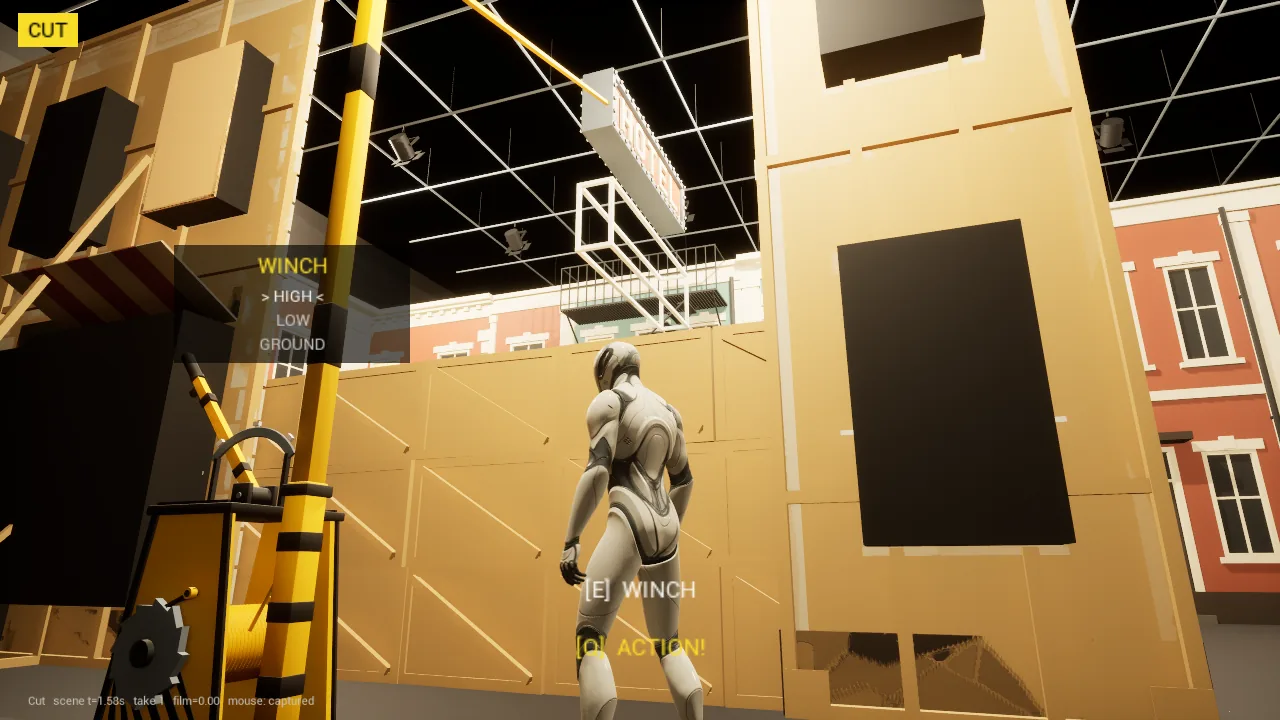
- The winch went back behind the scenery, reversing the morning's rule. It now stands behind a "wild wall" (a removable section of set) that disappears in CUT, and its 4-metre mast can be seen from the street. Reaching it means a real walk: 7.6 m, about 1.5 s of CUT in the keyboard run. That answers "you can solve it without walking".
- HIGH moved to 4.2 m. The window where only LOW can save you grew from about 0.18 s to about 0.37 s.
- Failing costs less: about 1.5 s instead of 2.7. The failure card can be skipped with R.
- Not adopted: restricting CUT to moments of danger. It would change the fantasy, and no one has tested it.
Every word on screen became translatable. This was the developer's decision. All player-facing text moved into Unreal's localisation system, with English as the source. There are no translations yet, and none are planned during the jam.
At 13:30 a new Windows build passed the keyboard scenario outside the editor.
Real art and real sound go in#
Two other agents had been working in parallel since lunchtime:
- Agent 02 (art) modelled the props in Blender, entirely through Python scripts. The geometry is original. It uses no third-party models, no generative AI, and no font: the letters on the sign are polygons.
- Agent 03 (audio) wrote prompts for 12 sound effects. At 12:56–12:59 it generated them through the ElevenLabs Sound Effects API, using the developer's paid plan. It then trimmed and levelled them with FFmpeg. The developer gave them a first approval by ear, listening outside the game.
The developer approved both deliveries for an experimental integration, and checkpointed the build first. One rule for the art: it is a visual layer. The grey boxes stay as the collision and the danger; they just stop being drawn where a model covers them.
That rule paid off at once. With the art in, every scripted scenario gave exactly the same numbers as before.
The first import didn't. A test cube came in at 1.8 × 1.18 × 1.0 cm, a hundred times too small. Re-importing with the unit setting switched on changed nothing, because a re-import reuses the options saved on the asset. Importing into a fresh folder with the setting on gave the right size. That became the rule for every import after it.
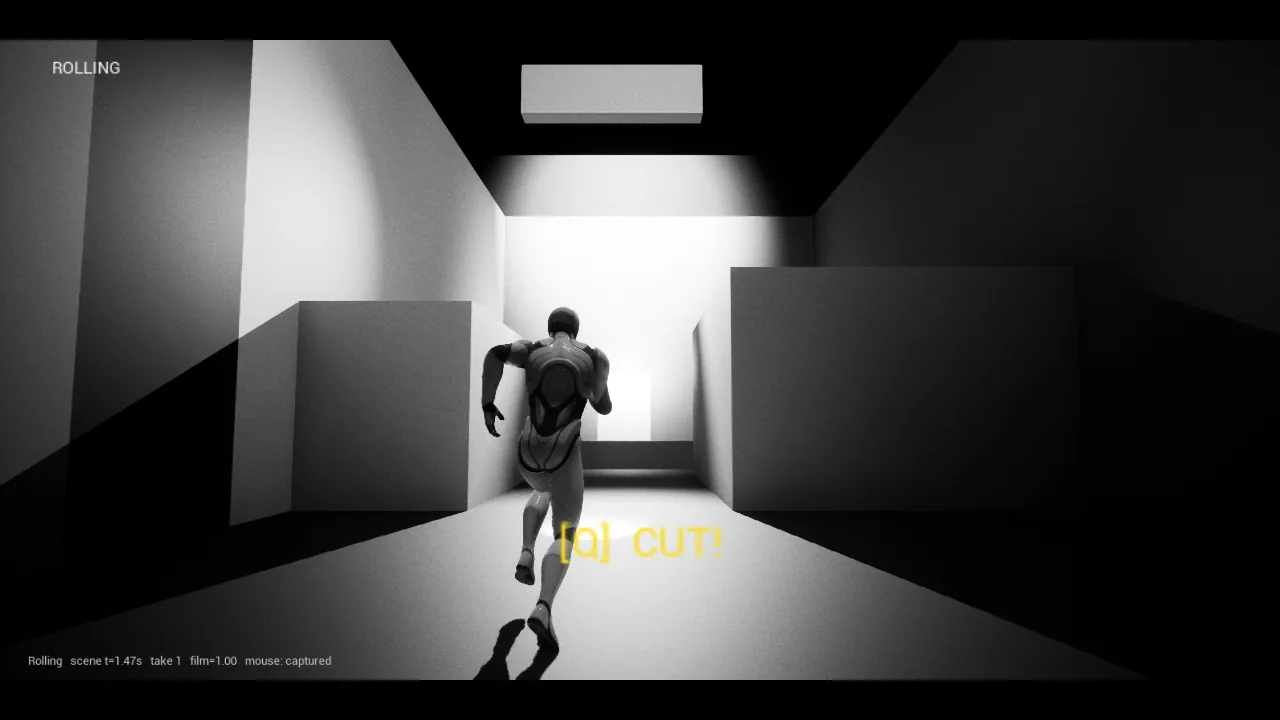
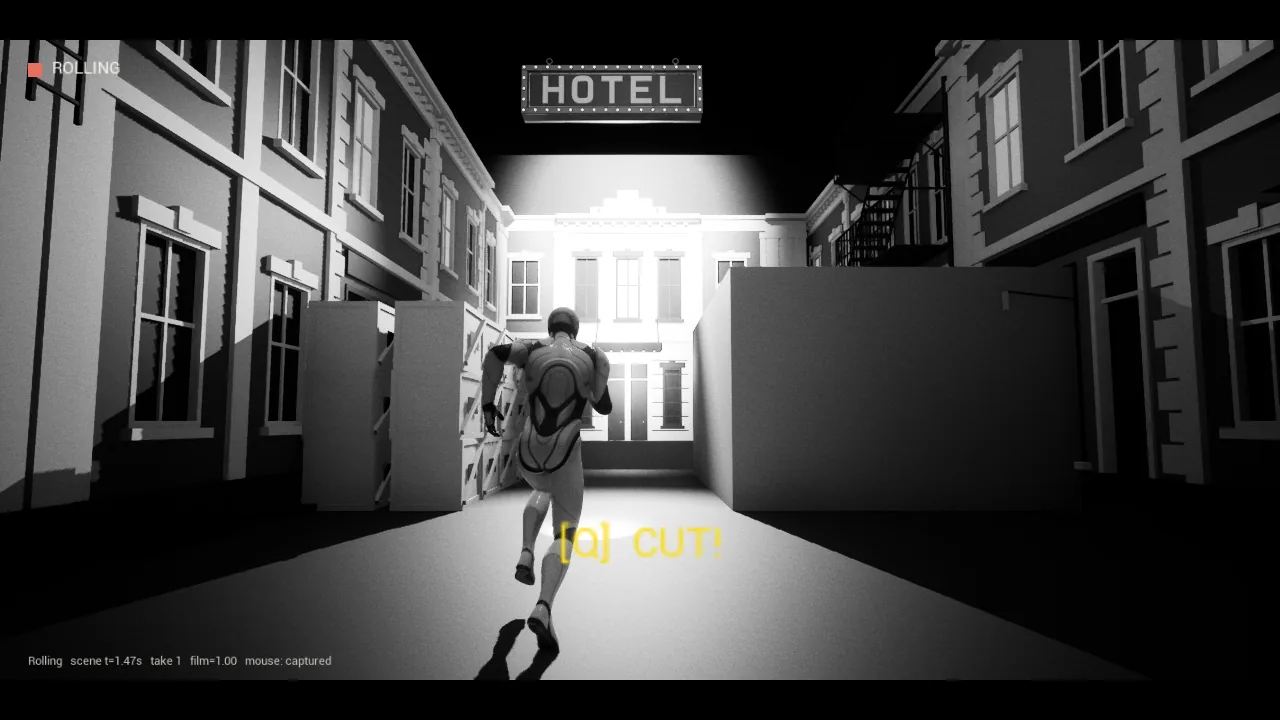
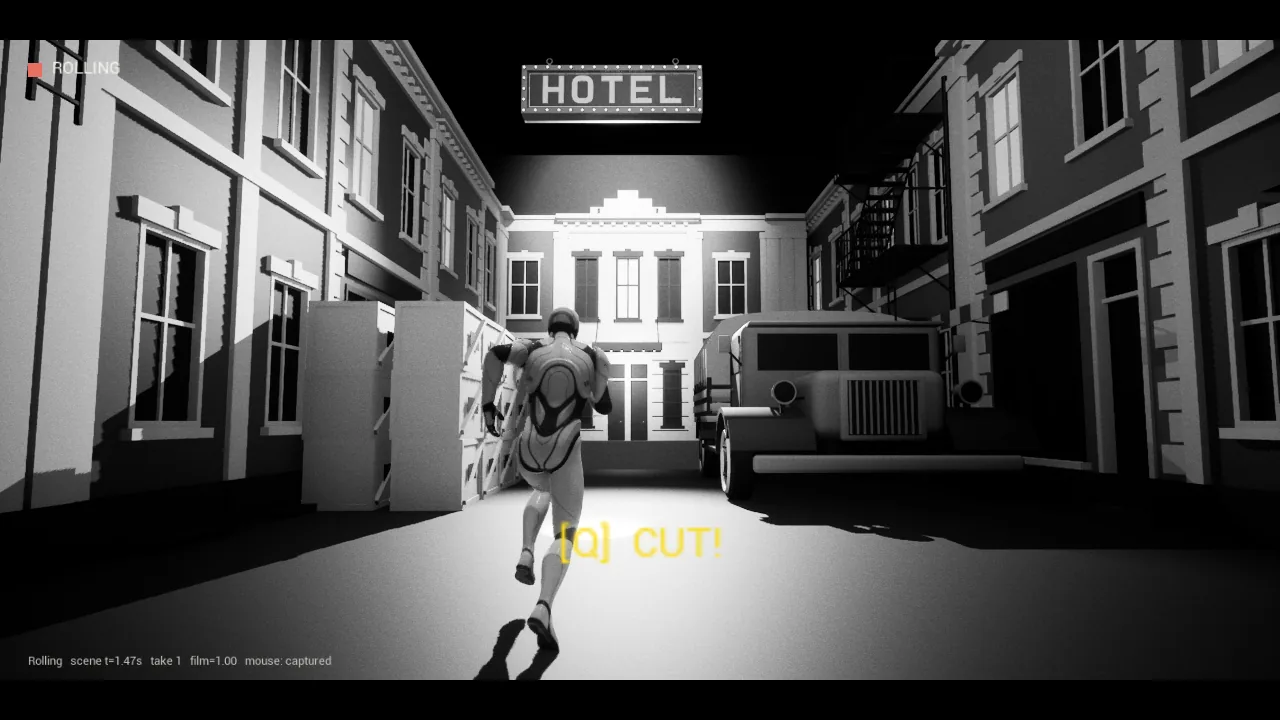
By 14:43 the street was dressed: shop fronts, the hotel entrance, fire escapes, a painted skyline, the soundstage walls, a lighting grid that only appears in CUT, and the crates. Here is the same frame of the same take, at 1.47 s, three times over:
 01ACTION
 02ACTION
 03ACTION
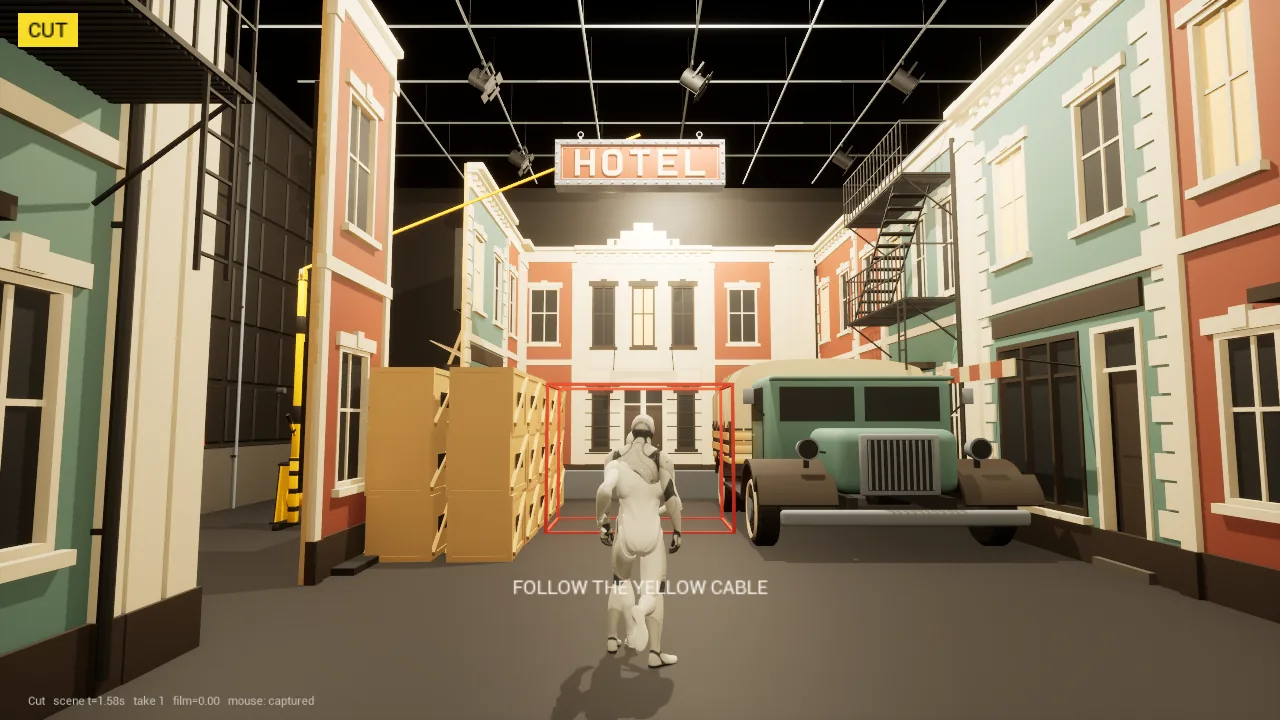 CUT
The sound follows the film's rules, not the computer's clock:
- A film sound only starts while the film is rolling.
- CUT pauses every film sound and the rain, and ACTION resumes them from the same point.
- The studio has its own room tone.
The game logs every sound it plays, so the timing could be measured. The warning creak, the fall and the catch each sounded within one frame of the exact moment (0.006–0.016 s late). In 30 back-and-forth cuts the log shows 30 CUT claps, 30 ACTION claps, and zero film sounds while the film was stopped.
What that doesn't prove: how it sounds. Nobody had heard the game. The scripted runs play in a window without focus, and Unreal mutes an unfocused game by default. The log proves order and timing, nothing more.
Problems found while integrating:
- The wrecked sign didn't match its collision. The wreck was about 1 m tall, but the box that blocks you is 2.3 m. Anyone trying to jump it would hit an invisible wall.
- The truck was still a white box in the middle of a finished street.
- The camera slid into awnings and fire escapes, which have no collision, when the actor hugged a facade. Five volumes that only the camera can see fixed it.
The first two went back to Agent 02.
"Too bright", and a light that never pointed where we thought#
The developer reviewed the integrated scene from screenshots and the report. They had not played it.
- They approved it as a stable technical base, and said so explicitly: not as fun.
- The ACTION/CUT distinction reads.
- ACTION is too bright in the background, especially the hotel.
- In CUT, the yellow equipment doesn't stand out from the plywood.
- The futuristic mannequin hurts the film's identity.
- The wreck and the truck need fixing.
The agent took the brightness first. It wrote a scenario that photographs six fixed views, and a script that measures each picture. Then it tested one hypothesis at a time:
| Hypothesis | Result |
|---|---|
| Automatic exposure | Confirmed. It swung by almost 4 stops depending on where the camera pointed. Tilting up at a black sky "opened" the exposure and burnt the hotel |
| The glowing windows and bulbs | Ruled out. Switching them off changed nothing |
| The light under the sign spilling onto the hotel | Wrong. Limiting its reach changed nothing; the change was undone |
So it switched the film's lights off one at a time. Only one made the hotel go dark: the spotlight the code described as "a back light on the actor".
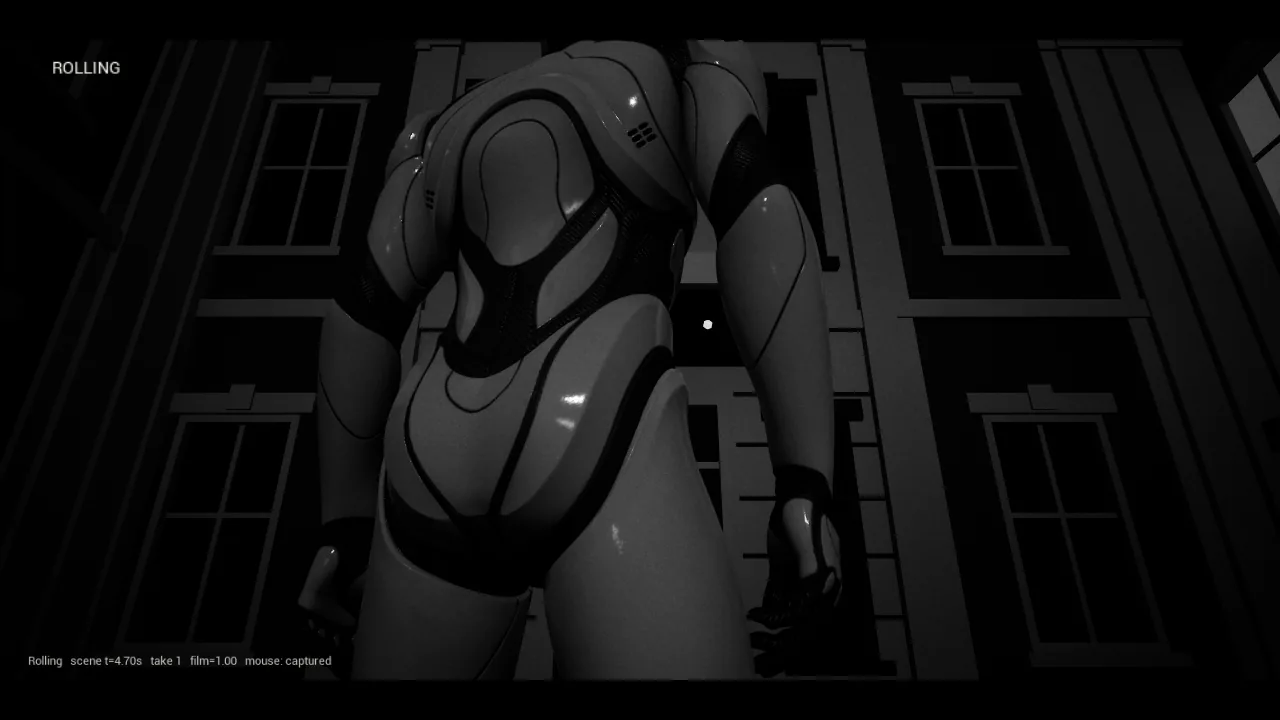
The cause was in the engine source. A spotlight is created already pointing down, and spawning it adds the rotation you give it to that. All four of the film's spotlights had been pointing 90° away from where the code said, since the first greybox that morning. The "back light" was a 90,000-candela floodlight aimed at the hotel. It was the agent's mistake, and no test caught it, because no test looked at light.
The fix was three numbers:
- a fixed exposure for the film look (CUT keeps automatic exposure);
- that floodlight cut to 13,500 cd;
- the lamp over the hotel door cut from 1,800 to 450 cd.
The agent deliberately did not re-aim the four spotlights. That would re-light a scene the developer had just judged; it is a decision for the developer.
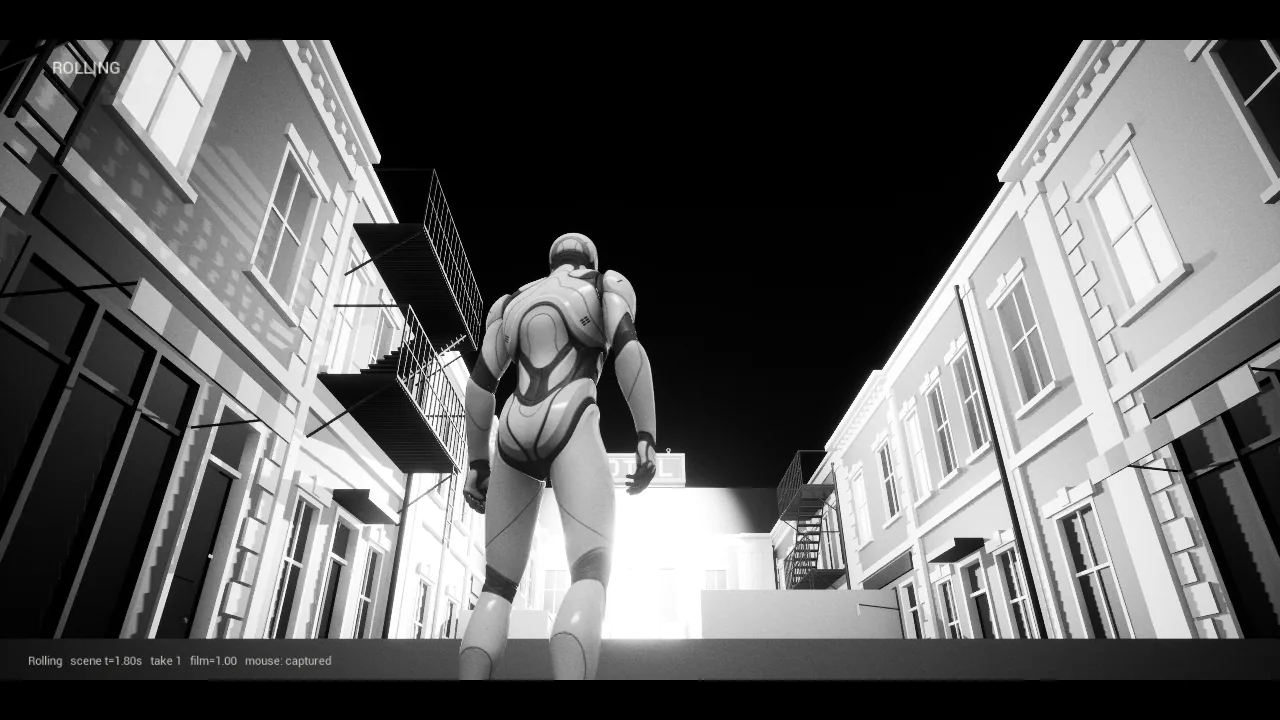 01
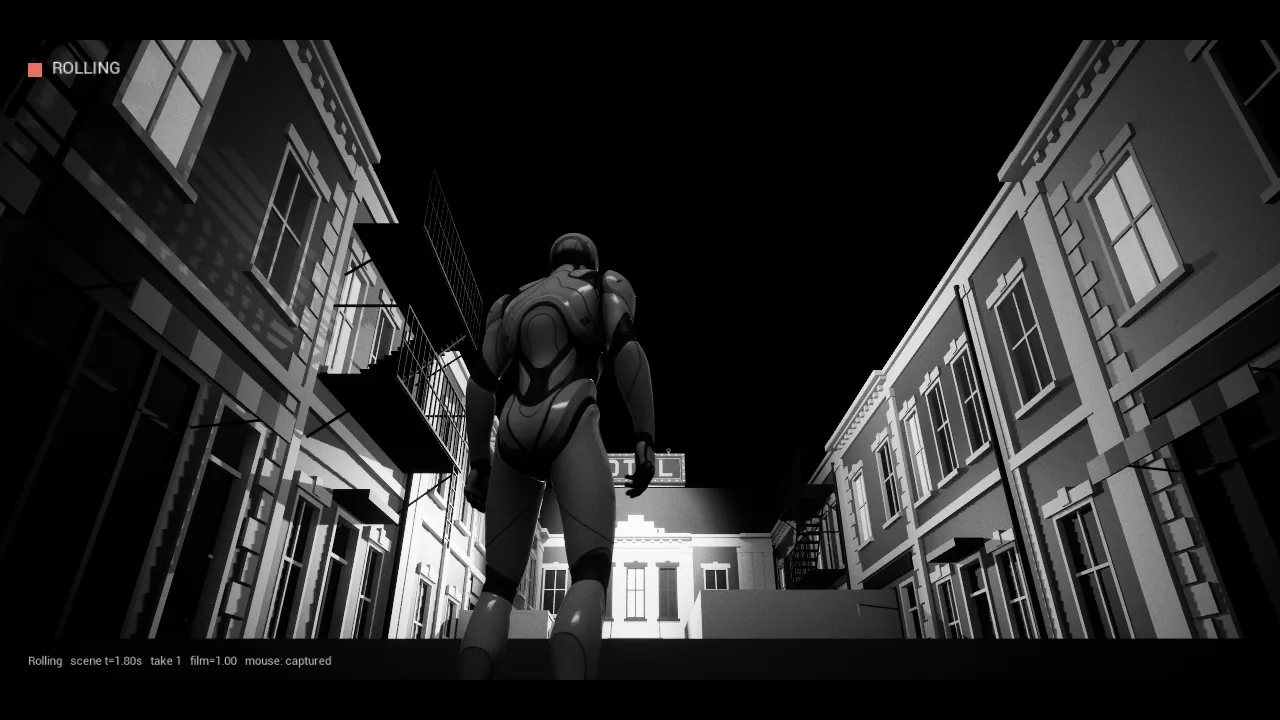 02
The side effect, measured and reported rather than hidden: the start of the street got darker.
Correction 01: one broken sign, a truck, a winch that reads#
Agent 02 remade three things:
- The wreck: one sign broken between the T and the E, with a pipe and a canvas curtain behind it.
- The truck: a real model, replacing the white box.
- The winch: black bands on the mast and a dark base.
The developer approved them for integration, with one condition: no new art requests without evidence of a real problem inside the game.
There was one. On the first import, the curtain was missing, and the hotel showed through the gap above the sign. The curtain is a single sheet: Blender draws both sides, but the game's material drew only one, and that side faced away from the player. The fix was a two-sided cloth material, made on the integration side. No art was sent back.
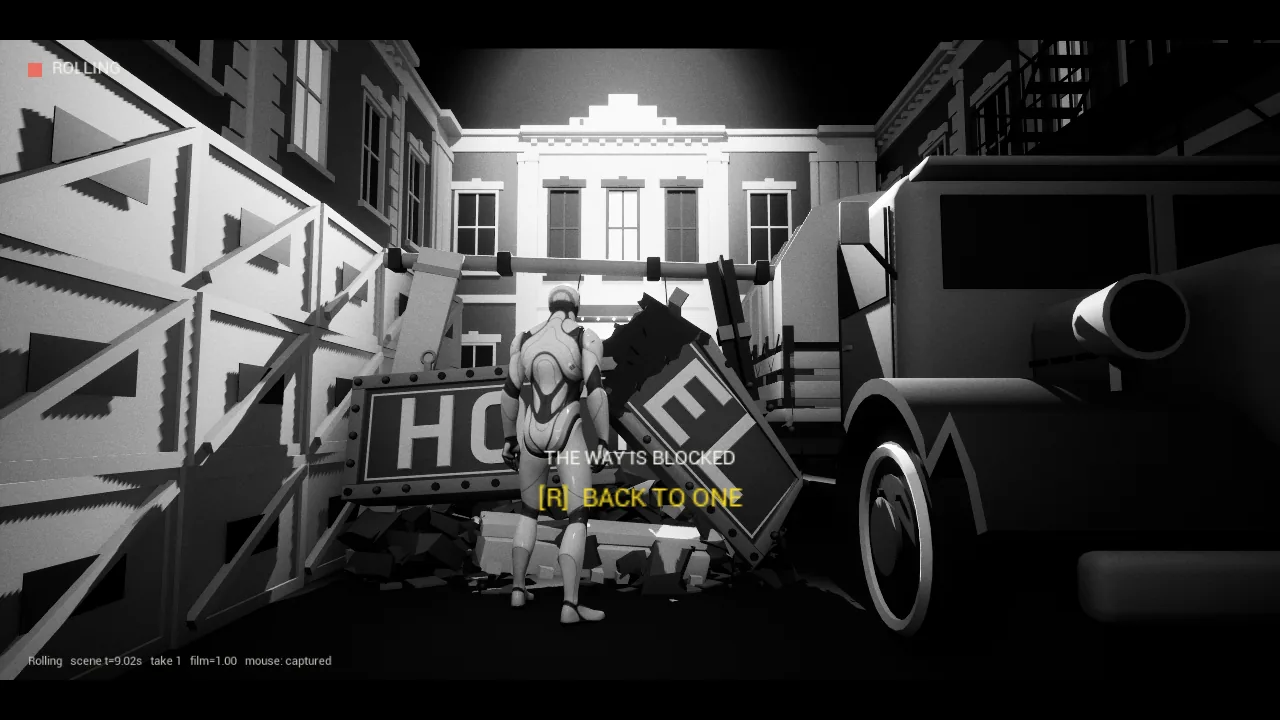 01ACTION
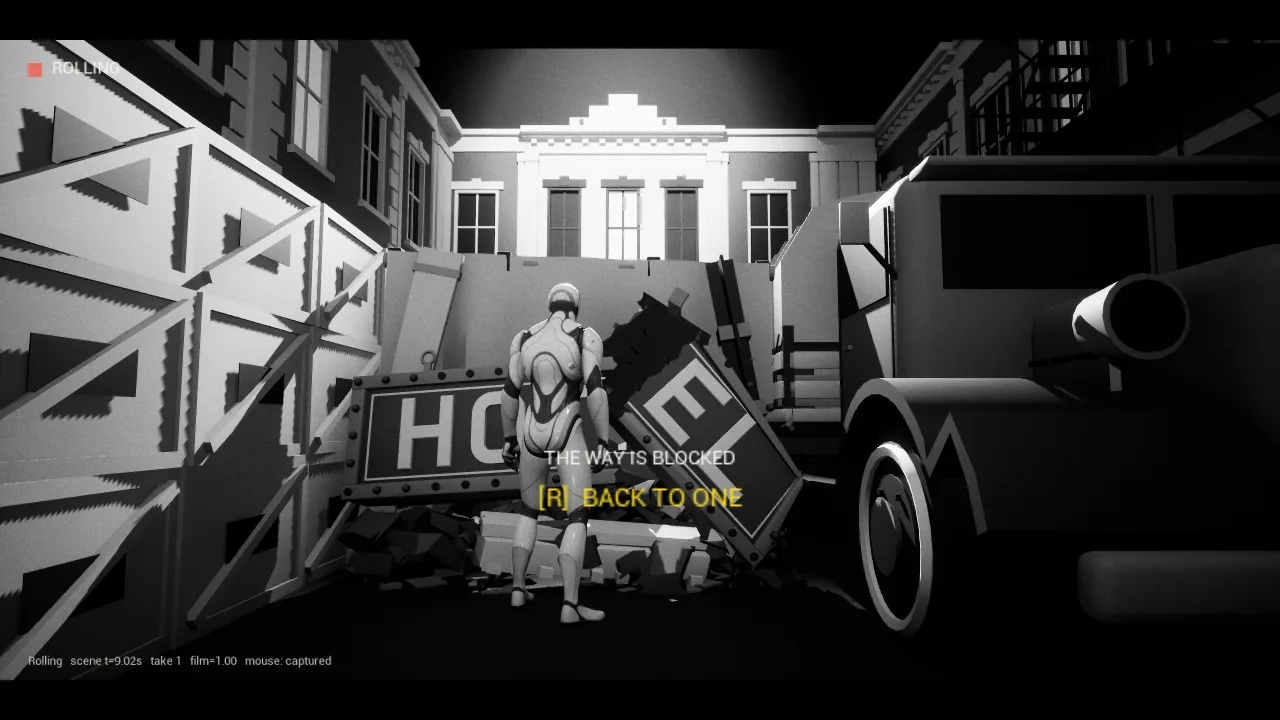 02ACTION
 CUT
 CUT
At about 16:08, the developer approved the result visually from the screenshots: the wreck, the truck and the winch are good enough for Scene 1, and not to be refined further for now. Next priority: a person playing it.
Answering the developer's questions turned up two things:
- The red box is not a debug leftover. It is the intended CUT preview of where the danger lands, never visible in ACTION and never solid. But the developer was right that it looks like one: its look is a placeholder, to be replaced in polish.
- There is a debug leftover. The grey line in the bottom-left corner of every screenshot in this log (mode, scene time, take, mouse state) is switched on in every build, packaged ones included. The developer decided it stays on in development builds, because it helps remote playtesting, and must be off in the build that ships.
Scene 2 starts as arithmetic#
The developer approved the concept for Scene 2: a car on rails and two rigs — a track lever and a pallet on a winch — whose settings only work in pairs. Six combinations, two solutions. They authorised only the maths and its tests, nothing on screen.
By 16:52 the agent had written the car, the track switch, a barricade and two new states for hanging loads, and checked them with 5 new automated tests (12 in total). To check the tests themselves, it broke two rules on purpose: a lever that never expires, and a car that never stops at the pallet. Three tests failed, as they should. It restored the code, and all 12 passed again. Scene 1's nine scenarios still gave the same numbers.
At 16:52 nothing of Scene 2 had been seen: no scene, no track drawn on screen, no preview. That changed within the hour.
Scene 2, The Chase, in grey boxes#
The developer authorised Scene 2 as a playable greybox, with conditions:
- previews drawn from the rules themselves;
- bigger margins on the jumps;
- rigs that don't need a tedious walk;
- a test at 20 frames per second;
- CUT always available;
- no new models, sounds or materials;
- stop before any polish.
The scene. A car on rails comes up behind you in a corridor 3 metres wide, with a barricade at the end. There are two rigs, both behind a wall that disappears in CUT:
- a track lever: MAIN LINE or SIDING;
- a winch holding a pallet of crates over the barricade: HIGH, LOW or GROUND.
The scripted take, MAIN LINE + GROUND, gets nobody through. Of the six combinations, only two open the way:
| Rigs | What happens | |
|---|---|---|
| A | MAIN LINE + HIGH | You shelter in an alcove; the car smashes the barricade; you run through the hole |
| B | SIDING + LOW | The car turns into a dead-end garage; the pallet stops low enough to be a step, and you jump the barricade from it |
In CUT the floor shows where each choice leads: the rails, a yellow band for the car's path, and outlines where the car, the pallet and the hole in the barricade will end up. The drawings come from the same calculation that decides what happens. Every scripted run that cuts compares what the drawings said with what then happened. They matched in all ten, at 60 and at 20 frames per second.
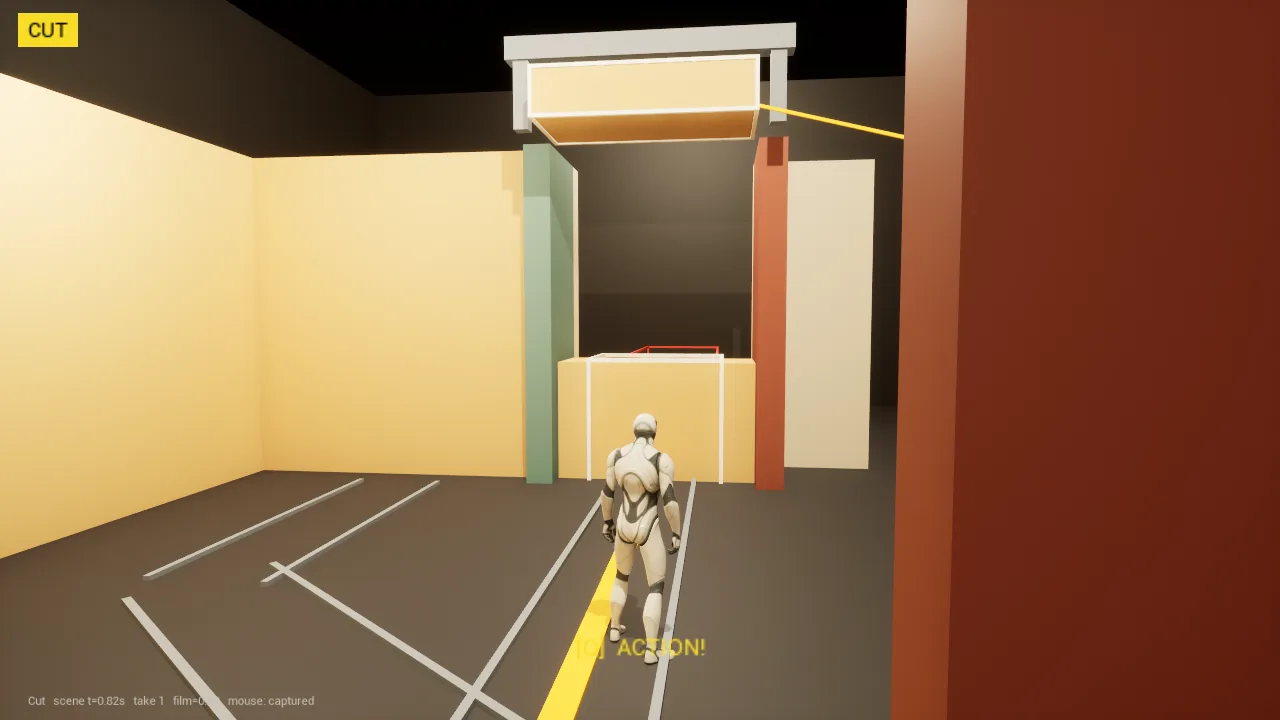 CUT
Screenshots caught three problems straight away, and they were fixed on the spot:
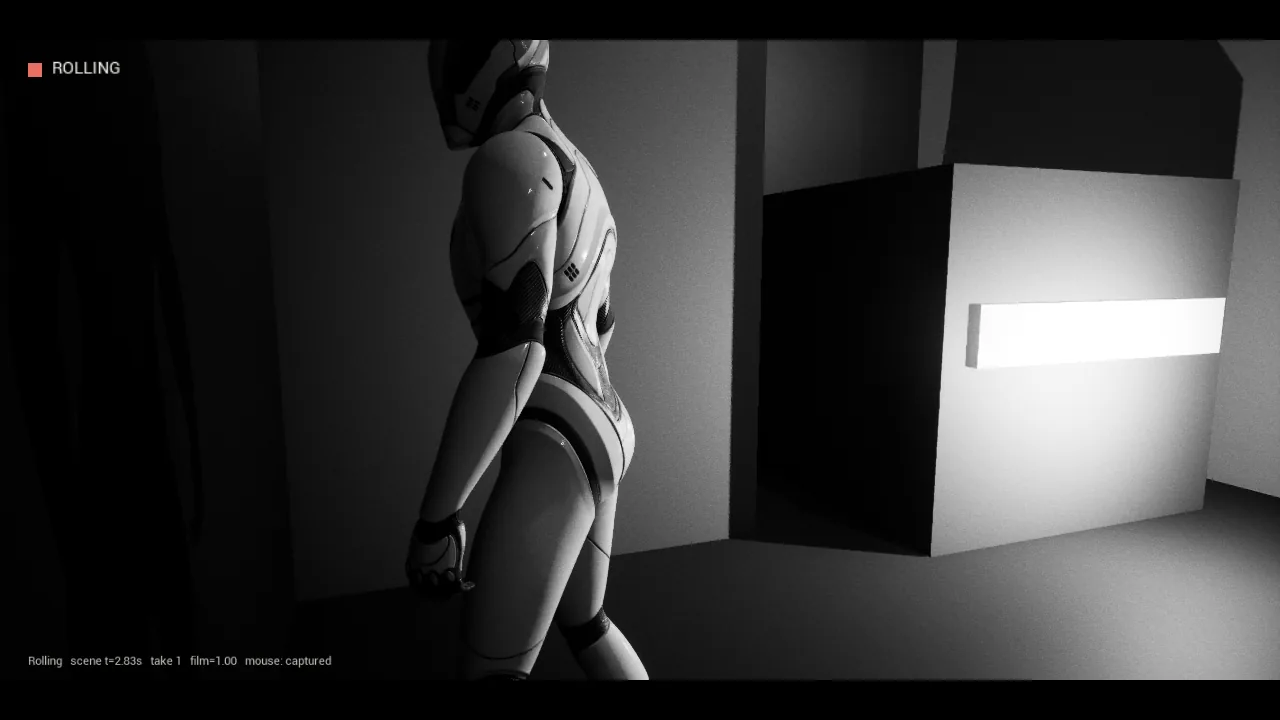
- ACTION came out white. The new lights were too strong for a bright corridor at fixed exposure (about 5,500 cd, cut to about 400).
- The camera pushed into the actor in the alcove. Making the alcove bigger helped, but didn't solve it.
- A test script was wrong: it expected the actor to step on the barricade, but in solution B they clear it in the air.
At 17:53 all 19 scripted runs of Scenes 1 and 2 passed, plus 5 at 20 fps, in the packaged build: 24 out of 24. Scene 1 still gave its usual numbers.
The agent also listed what it thought was weak, for the playtest to judge:
- the car makes no sound;
- the camera in the alcove;
- solution B doesn't need the alcove at all;
- on a first take, it's the pallet that kills you, not the car;
- the rigs are a step from the track, not a trip backstage.
The developer plays Scene 2#
The developer played the new scene and solved the puzzle. In their own report: they did not realise straight away that they had to shelter in the alcove and wait for the car to pass. Their verdict: the mechanic works; the way the game shows the shelter, and the moment to leave it, needs to improve.
This is a playtest, not a validation, and the developer asked for it not to be treated as more than that. This log records it as their report of 12 November; it doesn't give a time, a length or how they connected, because those weren't recorded.
 01
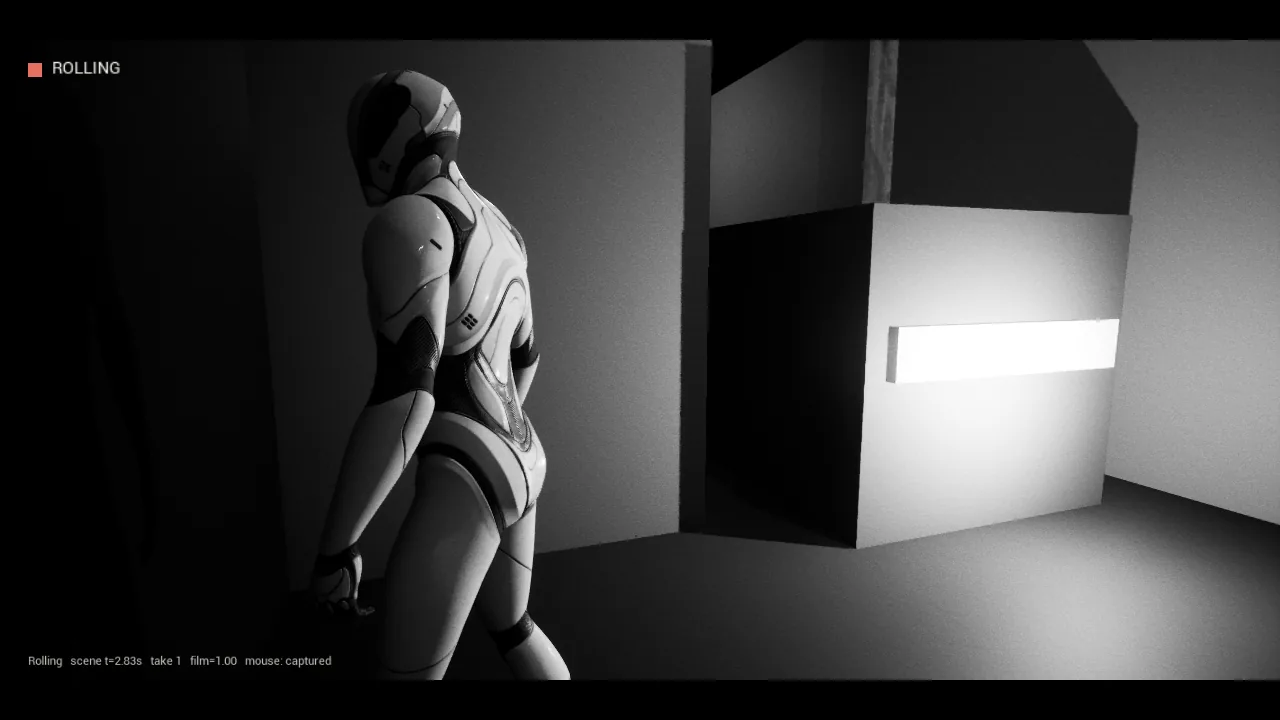 02
The developer decided:
- the greybox stays as the base;
- the six-combination logic stays, and the puzzle is not made easier;
- polish goes, in this order, to:
- making the alcove, and the safe moment to leave it, readable — without text that gives the answer away on a first take;
- giving the car a presence you can hear and see, approaching, passing and leaving;
- the camera in the alcove, without touching movement.
Scene 3, The Final Take#
The developer authorised Scene 3, with a risk assessment first.
The scene. A plaza, and a cinema front 9 metres tall that tips over onto it. A car crosses the plaza just before.
Here, staying alive and getting the shot are two different things:
- Under the falling wall, the front hits you.
- Anywhere clear of it, you survive — but the take fails: the director calls "YOU WEREN'T IN THE SHOT".
- Only where its open window lands are you both safe and in the shot. That is the only place the take prints.
There are three taped marks on the ground, A, B and C, and a newsstand stands on B. Two rigs:
- a wagon under the front: MARK A, B or C, which moves where the window will land;
- a track lever for the car: MAIN LINE or SIDING.
As scripted, the window lands around the newsstand, with no room for you: the scene can't be completed without directing it.
What the risk assessment found, before any code: the part of the window where you survive is smaller than the window itself. The top of the frame sweeps past head height before it reaches the ground. A chalk box drawn the size of the window would have killed players standing inside it. So the window grew, and the chalk box shows the real survivable area, using the actor's height measured in the game.
The agent made a mistake on the way:
- It sized that box for a body 190 cm tall, but the actor's collision is 191.1 cm.
- The game did the right thing; it was the test script that rejected a correct solution.
- It was fixed with the measured number.
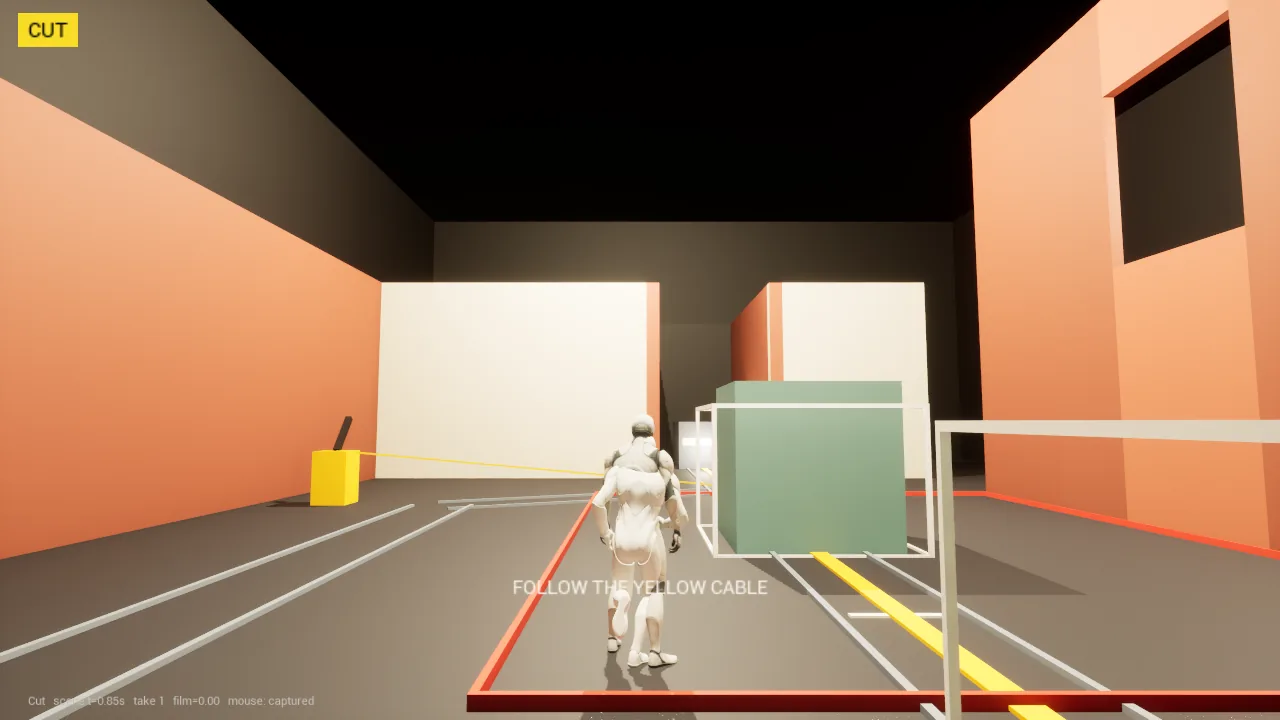 CUT
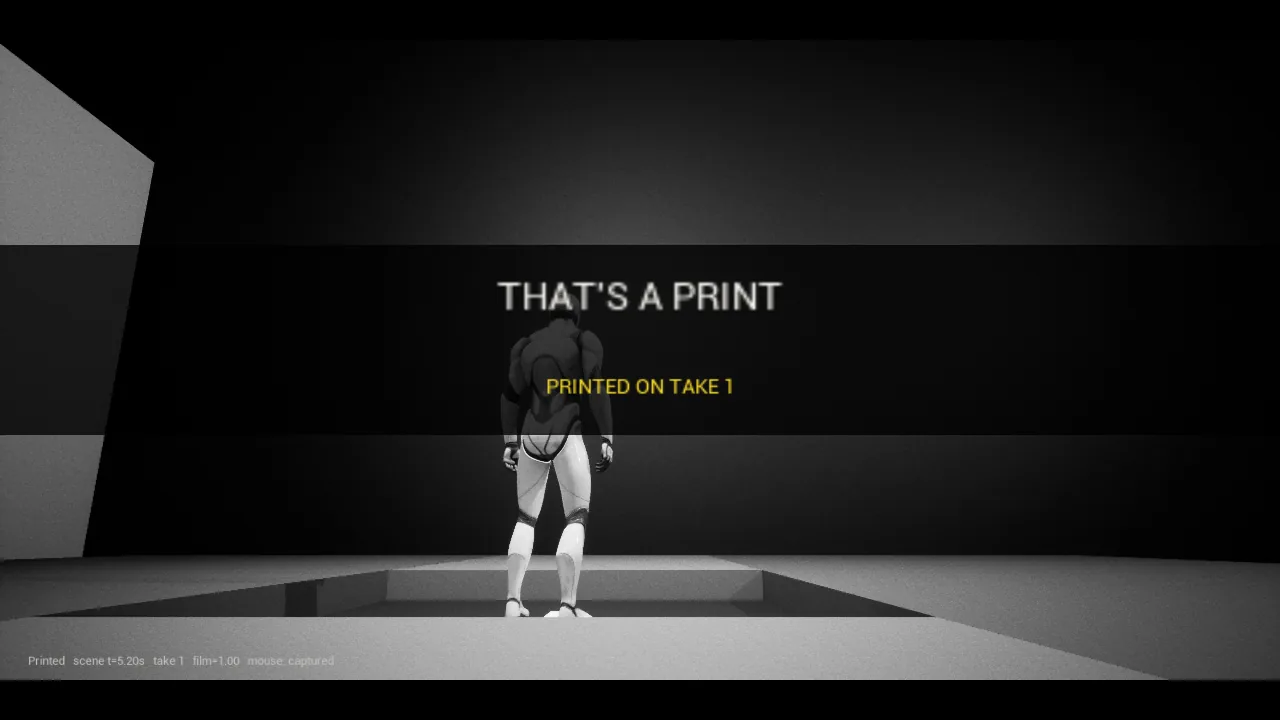 ACTION
Three solutions work in scripted runs:
- A: move the window to C, and run in after the car.
- B: move it to A and send the car down the siding — then just stand still.
- C: move it to A and run in behind the car, with 0.4 s to spare.
The first complete game#
With Scene 3 in, the game runs from the first slate to the end. Each printed scene cuts to the next. After Scene 3 the work lights come on by themselves — the last CUT isn't the player's — and a closing card shows the take each scene was printed on. "SHOOT IT AGAIN" starts the production over.
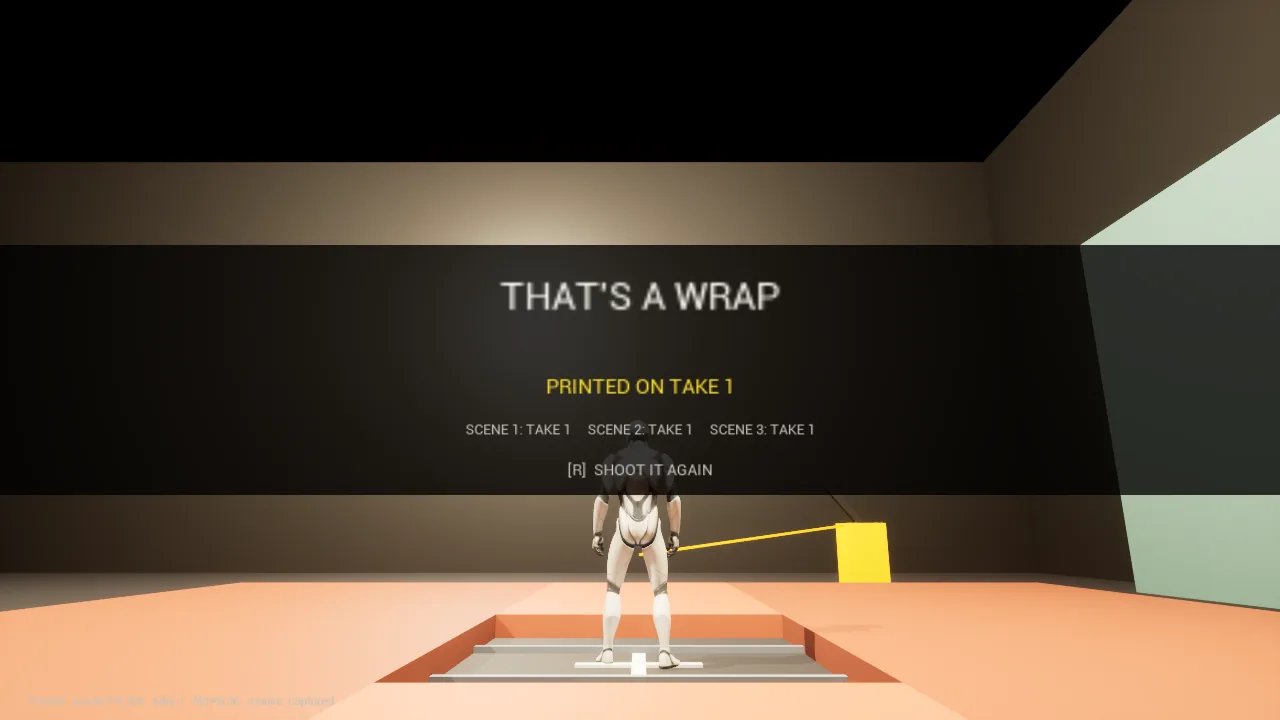
What was checked, and how (all by Agent 01, with nobody watching; every line below is in the run's log):
| Check | Result |
|---|---|
| Automated tests | 14/14 |
| Scripted runs, three scenes, 60 fps — including one that plays all three in a row | 27/27 |
| Scene 3 at a fixed 20 fps | 8/8 |
| Windows build (Development) | Packaged, 763 MB |
| The 27 runs at 60 fps plus 8 at 20 fps, in the packaged build | 35/35 |
An earlier full pass (18:39–19:02) was thrown away. The screenshot of the front coming down was too dark to read, so the light was raised and everything was run again. The table is the second pass.
Frame times came out between 7.5 and 14.7 ms in one pass and between 6.6 and 8.9 ms in the other. They depend on what else the machine was doing, so they are not a measurement.
What this milestone is not:
- It is not finished. Scenes 2 and 3 are grey boxes, with borrowed or missing sounds.
- It is not validated by a person. The developer has played Scenes 2 and 3 separately (see their reports), but nobody has yet played the whole sequence, start to wrap, after the polish.
- Not everything is covered by tests: the director's new way of judging a scene by position has no automated test of its own, only scripted runs.
- There is no final build yet. No Shipping build, no ZIP.
The developer plays Scene 3 — and what the playtests are steering#
The developer also played Scene 3. In their own report:
- They set the rigs correctly, but the take failed: they weren't in the right position when the front came down.
- They hadn't understood why they needed to be on that mark.
- They liked the overall result, though they found the solutions relatively easy.
That is exactly the gap between surviving and getting the shot — and the game hadn't made it clear. It also matches two weaknesses the agent had listed before anyone played:
- In ACTION, only the taped crosses mark the spot. The chalk box — where you are both safe and in the shot — only shows in CUT. In the film, you have to remember it, and nothing says why that spot matters.
- You only find out you missed the shot when the front lands, up to 4.6 s later.
"Relatively easy" matches a third item on that list: Scene 3's simplest solution asks for no execution at all — two rigs, then stand still.
So the polish now under way follows what a person found, not a list of features:
| Finding (by a person) | Direction |
|---|---|
| Scene 2: the alcove, and when to leave it, aren't read straight away | Decided by the developer: make the shelter and the safe moment readable without giving the solution away; give the car presence; fix the camera in the alcove. The puzzle stays as hard as it is |
| Scene 3: not knowing why you must be on the mark | Make "be in the shot" readable in ACTION, not only in CUT, and the result understandable sooner |
| Scene 3: the solutions felt relatively easy | Recorded. No decision yet |
That work is in progress and not yet committed. This log will say what changed, and whether the next playtest found it clearer, once it has happened.
Where Day 1 stands at 19:35#
| Status | |
|---|---|
| Verified automatically | 14 automated tests. 35/35 scripted runs in the packaged build, including all three scenes in a row ending on the wrap card. Sound timing measured from the game's own log |
| Played by a person | The developer played Scenes 2 and 3, separately: Scene 2 solved; Scene 3 rigged correctly but the take missed. The Scene 1 art was judged from screenshots, and the 12 sounds got a first approval by ear outside the game |
| Not yet | A complete, reliable playthrough of the whole sequence after the polish. Art in Scenes 2 and 3 (the goal; greybox is only the fallback). Frame rate measured while playing. A final (Shipping) build |
Is it fun? Not known yet. The developer liked the overall result of Scene 3, found the solutions relatively easy, and showed where two scenes don't read. That steers the polish; it isn't a verdict on fun.
What went wrong on Day 1#
- Another project's editor blocked the build twice — compiling at 11:11 and packaging at 11:53. Both were fixed with flags, without touching the developer's editor.
- Five design and rule problems turned up from real output, not code review (see the table above).
- Three early "failures" were bugs in the test scripts, not the game. One scenario never cut, one never reached the moment it was supposed to test, and one ran only the first of its scenarios because of how PowerShell passed a list.
- One automated screenshot didn't show what its label said. It was filed as "the stand-in frozen mid-air", but it was taken a frame late and shows the white flash of the return instead. We caught it while writing this log, left it out, and corrected its label.
- The first human test was blocked by the mouse, not the design. The fix is measured, but not yet confirmed in a real remote session.
- The mouse test took over the developer's real cursor while they were working remotely. They stopped it twice; it now needs their go-ahead.
- Three of the agent's own hypotheses were wrong: two about the mouse and one about the exposure. Each was disproved by a measurement before anything shipped on it.
- Every spotlight in the film pointed 90° away from where the code said, from the first greybox onwards. It was found only by measuring screenshots, almost four hours later.
- Imported models came in 100 times too small, and re-importing didn't fix it. The import options are saved on the asset.
- A canvas curtain was invisible from the side that matters: a one-sided material on a single sheet.
- The first wreck blocked more than it showed. Its collision box was more than twice as tall as the model.
- The audio import script called a function that doesn't exist in the editor's Python. It was fixed by reading the property directly.
- A debug line has been on screen in every build, packaged ones included. It must be off in the final build.
- Scene 2's first lights burnt the picture white, and its first alcove was too small for the camera. Both were caught from screenshots.
- Two test scripts were wrong, not the game. One expected the actor to land on the barricade; one used a body 1.1 cm shorter than the real one.
- A whole verification pass was redone because one screenshot was too dark to show what it was meant to.
- The two human findings of the day were about reading, not rules. The rules held in every scripted run, but a person still didn't see the shelter (Scene 2) or the required spot (Scene 3) straight away.
Day 1, after dark#
Day 1 ended at 19:35 with a complete game in grey boxes — and with a playtest that showed what was missing. In Scene 3, the developer set every rig correctly and still failed, because nothing had told them why they had to stand on that mark. The rule existed in the design documents and on a failure card. The game only said it after punishing you.
The rest of the evening went into fixing that, putting sound on the two new scenes, and a second playtest.
The shot is explained before it can be missed#
The developer decided: no new puzzles, rigs or scenes. The three scenes become the technical base, and the priority is that they make sense.
The lead agent's diagnosis was blunt: the defect was communication, and it was the agent's. It had even listed "in ACTION, only the taped crosses mark the spot" as a known problem, and left it for the playtest to judge.
What changed:
- Before you can fail: the slate of the first take now carries a card called THE SHOT — one sentence and an animated diagram.
- In ACTION: your mark is drawn on the floor in pale tape, with a YOUR MARK label and its distance. The label was extended to Scenes 1 and 2.
- In CUT: chalk shows the path of the falling front and where it will land; everything that isn't safe is hatched in red.
- Missing the shot has its own failure card, different from being hit.
- The first pass at a climax: a tremor before the fall, a camera jolt on impact, a held silence before the verdict, then a cut to a frontal shot.
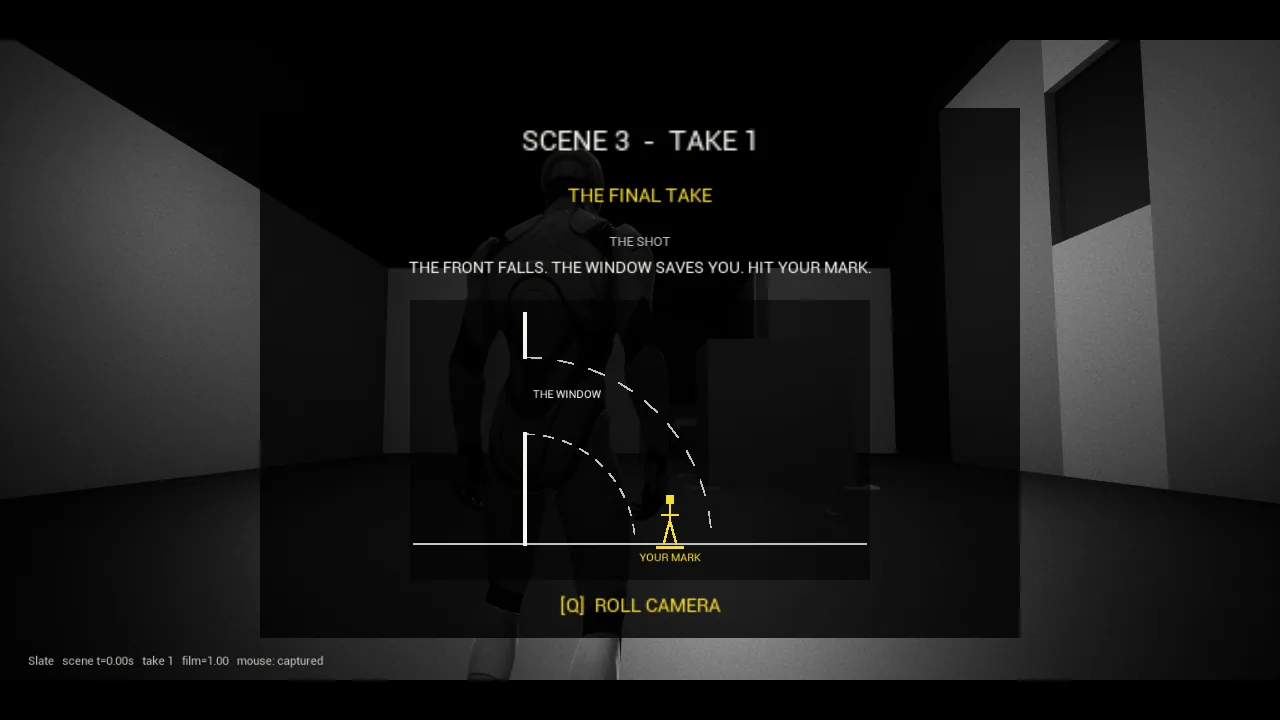
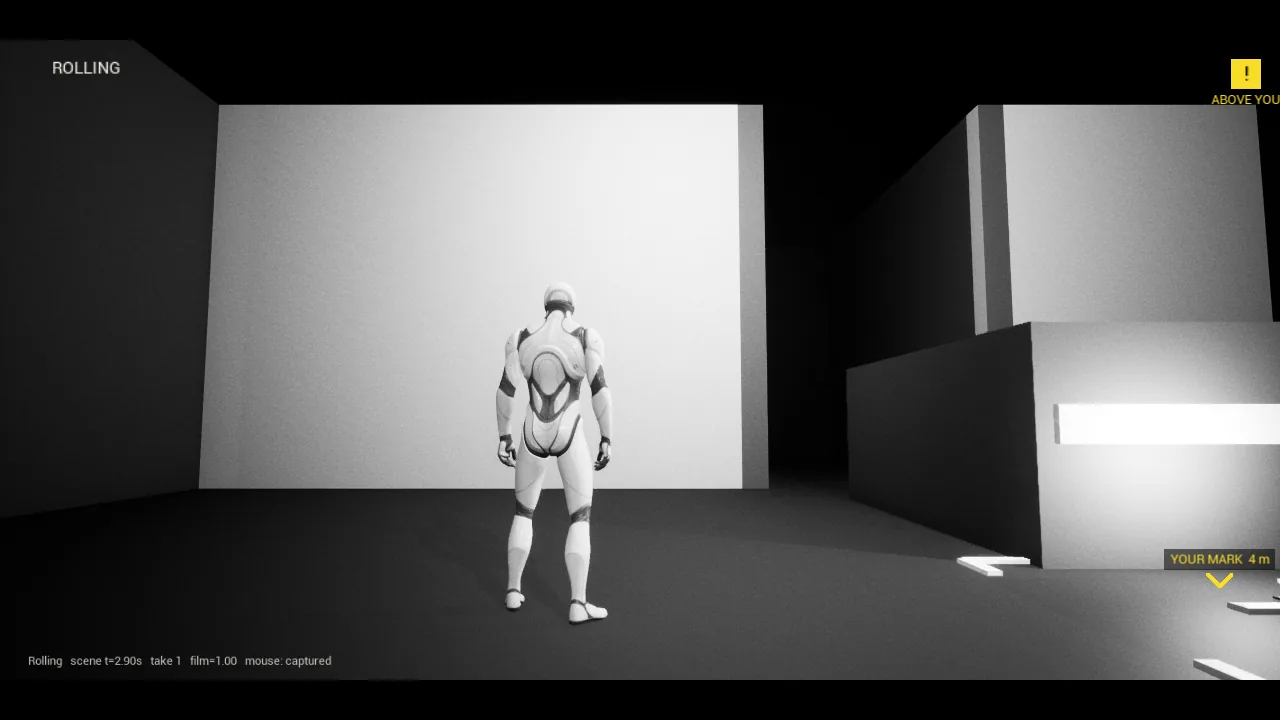 ACTION
Two of the agent's own mistakes on the way: the first new test failed because the test itself was set up wrong (the scene was missing the front), and the first print camera showed the actor from behind against a black wall, with the card covering them. Both were caught from the output, not by a person.
| Check (by the lead agent, nobody watching) | Result |
|---|---|
| Automated tests | 15/15 |
| Scripted runs, all three scenes | 28/28 |
| Scene 3 at a fixed 20 fps | 9/9 |
| The same runs in the packaged Windows build | 38/38 |
Not proven: that the rule is now understood. Only a player can say that.
Eight sounds for the car and the cinema front#
The audio agent had generated eight effects for Scenes 2 and 3 with the ElevenLabs sound-effects tool (243 credits); the developer gave them a first approval by ear. The lead agent integrated them, following the audio agent's written plan:
- the engine, the rails and the pass-by sound are attached to the moving car, with distance falloff;
- the engine never drops more than 12 dB, so you can hear the car coming from behind;
- the front creaks on the scene clock, falls, and hits on the exact frame it lands;
- CUT pauses every film sound — including ones still fading out — and ACTION resumes them.
In every scripted run: zero film sounds audible in CUT, zero events outside the rolling film, zero duplicate starts.
Timing the pass-by took four attempts. The first three were wrong: one ignored a car passing at an angle, one measured from the camera (which jumps with the mouse) and fired at "33,294 cm/s", one fired while the car was still pulling away. The fourth measures the actor's body along the car's line.
Not proven: how any of it sounds. Volume, weight, whether you really hear the car behind you — those are a listener's call.
A second playtest, a truck and a cinema#
The developer played the build again:
- the sounds were good enough for now;
- in Scene 2, the moment to take shelter came too early: there was no time to recognise the car by its sound;
- in Scene 3, they won by changing a single rig and timing their run around the car — easy, for a climax.
Both findings went into analysis, not into code. In Scene 3, on that route, the car passes the mark early enough to be a metronome rather than a threat. In Scene 2, the cue sits only 3.5 m from the shelter: a running player has about half a second between the first sound and the alcove.
Meanwhile the art agent's next pieces went in: a second version of the Scene 1 truck, and the cinema front for Scene 3, with a key light for its fall.
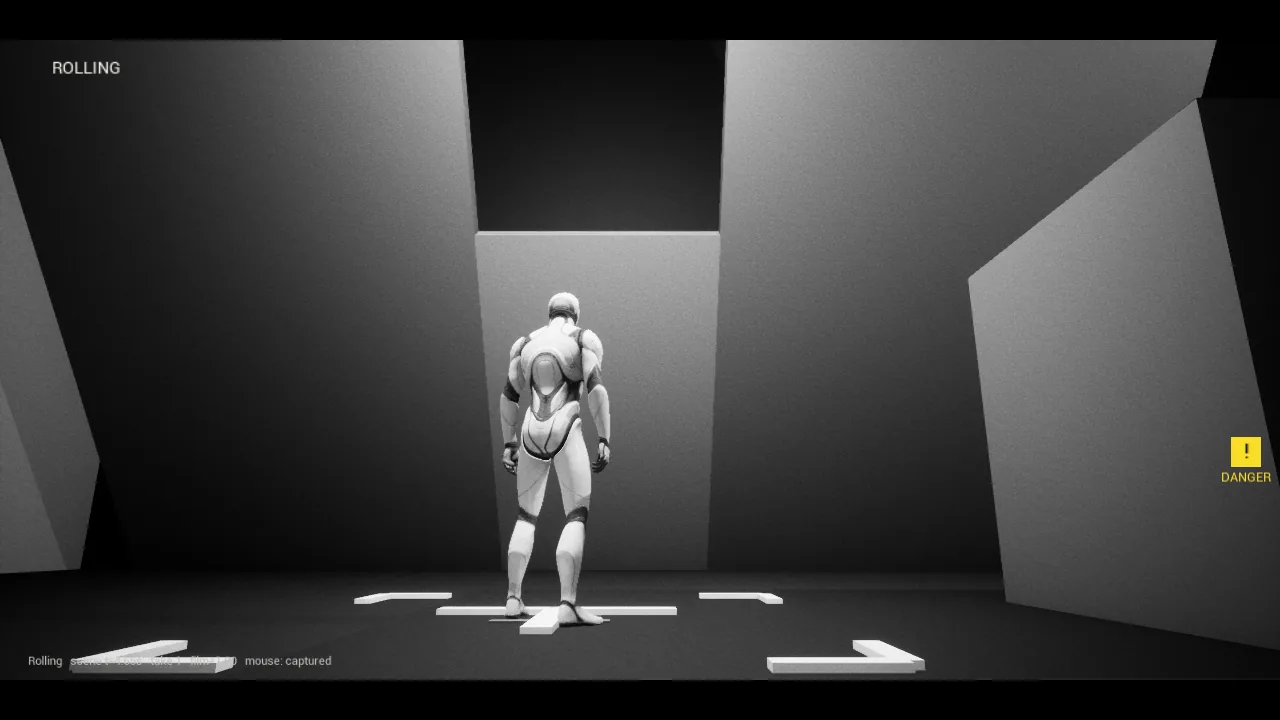 01ACTION
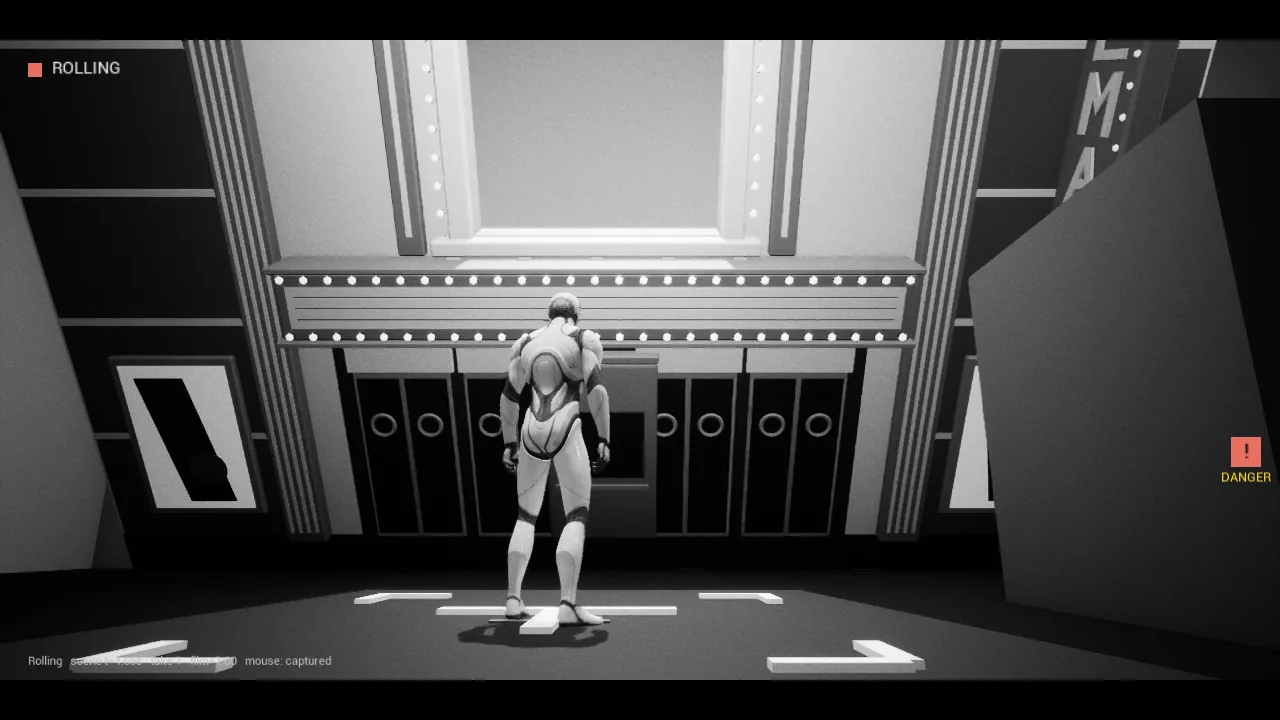 02ACTION
One defect turned up and was fixed: with the detailed front casting shadows, the engine printed a shadow-map overflow warning on screen. The hidden boards now cast the shadow instead, and the warning disappeared from every log.
Packaged build: 38/38 scripted runs, both new models loaded, no missing materials. Whether the truck and the front look right was left to the developer, with side-by-side captures.
The AI Workflow#
The cast#
| Role | Who | Day 1 status |
|---|---|---|
| Director — decides, approves, plays, submits | The developer (human) | Approved the plan, every integration and every new scene; set the priorities; reviewed art from screenshots and sound by ear; played Scenes 2 and 3, and their findings now steer the polish |
| Agent 01 — lead designer and integrator; the only one allowed to touch the Unreal project | Claude in Claude Code | Wrote every document, all game code and scripts; imported and integrated art and sound; ran every build and test |
| Agent 02 — 3D art and assets | Claude in Claude Code, its own session | Modelled 21 props in Blender by script, in three deliveries (Lot A, Lot B, Correction 01), all integrated. Has proposed a noir protagonist to replace the mannequin, and covers for the store page. Both await the developer's review; nothing of them is in the game |
| Agent 03 — audio | Claude in Claude Code, its own session | Generated and processed 12 sound effects and ambiences; wrote the rules for when each one plays. All 12 integrated |
| Agent 04 — level design review and QA | Planned, as a short-lived helper | Not used yet |
| Agent 05 — this dev log | Claude in Claude Code, a separate session branched from Agent 01's | Started at ~12:30; Day 1 chapter, evidence map, store-page drafts |
Why only one agent touches the game. Unreal's asset files are binary and can't be merged, so two agents editing the same level would overwrite each other. The editor's AI connection takes one command at a time, and two builds can't run at once. So the other agents work in their own folders, hand over files with a written report, and Agent 01 integrates. Separate agent sessions don't share memory, so coordination runs on plain files and Git history.
The dev-log agent works on its own copy of the repository (a Git worktree, on the branch agent/devlog). It never edits Agent 01's files or the game.
Who did what on Day 1#
| Work | Who | How it was checked |
|---|---|---|
| Concept, title, the three-scene idea | Developer (before the jam) | — |
| Planning brief | Developer (12 Nov, before any code) | — |
| Reading the rules; checking the machine and the engine | Agent 01 | Findings written into the project documents |
| 20 design and production documents | Agent 01 | Developer reviewed and approved the decisions |
| Choosing C++, determinism, the rail car, the finale | Agent 01 proposed; developer approved | Decision log |
| Test the compiler first; Git first; early playtest; don't advance on a weak core | Developer | — |
| All game code and scripts | Agent 01 | Compiler output; automated tests (4 in the morning, 12 by 16:47); scripted scenarios (8, then 10) |
| Five design fixes after the first screenshots | Agent 01 | Scenarios re-run, all passing; reworked in the afternoon pass |
| Self-critique of the design | Agent 01 | The developer adopted it as the next brief |
| First playtest attempt (Scene 1, ~12:00) | Developer | Blocked by mouse capture over remote desktop |
| Mouse investigation and remote-desktop mouse mode | Agent 01 | Outside test with injected input (53% → 98% at the window edge). Not confirmed in a real remote session |
| Make all on-screen text translatable | Developer decided; Agent 01 did it | Scenarios re-run |
| 3D models: sign, wreck, winch, street, soundstage, truck | Agent 02 (Blender, by script) | Imported sizes checked against the artist's table (within 0.05 cm); scenarios give the same numbers; screenshots |
| 12 sound effects and ambiences | Agent 03 (ElevenLabs API, FFmpeg) | Developer's first approval by ear, outside the game. Timing measured from the game's log; not heard in play |
| Integration of art and sound; material and camera fixes | Agent 01 | 10 scenarios pass in the packaged build; screenshots |
| Exposure investigation and fix | Agent 01, after the developer flagged it | Six fixed views measured before and after |
| Visual review of the art | Developer | From screenshots; approved for Scene 1 |
| Scene 2 concept; what to build first | Agent 01 proposed; developer approved and limited the scope | 5 new automated tests, checked by breaking the rules on purpose |
| Scenes 2 and 3 in greybox; scene transitions; closing card | Agent 01, within limits set by the developer | 14 automated tests; 35/35 scripted runs in the packaged build |
| Scene 3 risk assessment (the survivable area is smaller than the window) | Agent 01, at the developer's request | Found by calculation before any code; covered by a test at 60, 20 and 5 fps |
| Playtests of Scenes 2 and 3 | Developer | Their own reports. Not a validation |
| Polish priorities after the playtest | Developer | — |
| The BETWEEN TAKES logo (wordmark, diagonal cut in the K) | Developer, with GPT Astra; vectorised by script | Approved by the developer |
| Manual edits to code | Nobody | None recorded on Day 1 |
Where automation worked, and where a person was needed#
- Worked: writing and compiling code; reading the engine's own source to diagnose a build error; testing rules by running the game headless; catching design problems from screenshots the game took of itself.
- Also worked: importing models and sounds, and making materials, through scripts, without opening the editor; measuring screenshots to find a lighting bug.
- Needed a person: approving the plan; deciding which instructions mattered; noticing that ACTION was too bright and that the mannequin looks wrong; listening to the sounds; playing, and finding where a scene doesn't read — which no scripted run could have told us; judging whether anything is fun, which hasn't happened yet.
- Proposals not adopted: restricting CUT to moments of danger (held until it is justified and tested). The agent's own morning fixes — the winch on the street, the self-tilting camera — were reversed in the afternoon pass.
Tools used on Day 1#
Used to make the game: Claude Code (Anthropic) · Unreal Engine 5.8.4, including its editor Python plugin for scripted imports · the Visual Studio 2026 C++ compiler, through Unreal's build tool · Git and Git LFS · PowerShell, Bash and Python for scripts · the game's own screenshot function · Blender 5.2 (art, by script) · ElevenLabs Sound Effects API (12 sounds) · FFmpeg (sound processing).
Which Claude models. The session records show Claude Code 2.1.321 throughout, and three models:
- Claude Fable 5.2: the lead agent (design, code, integration, tests);
- Claude Opus 5.5: the art and dev-log agents and short-lived helper agents;
- Claude Sonnet 5.5: the audio agent.
Used for the game's identity: GPT Astra, used by the developer on 12 November to create and refine the BETWEEN TAKES logo: a serif wordmark with a diagonal cut through the K. The approved image was then traced by script (potrace) into a vector file of 12 shapes, with no font files and no embedded images.
Tried for exploration, not in the build: Tripo AI, used by the developer to generate a base model for a possible noir protagonist. Nothing made with it is in the game. (Update, 15 November: this changed on Day 2. The detective in the game is built on the model the developer generated with Tripo AI. See the final tool list.)
Not used yet: Unreal MCP, any texture generator.
Tools and assets#
Two lists, kept apart on purpose: what is in the build, and what was only tried.
In the build (as of the 12 November build):
| What | Source | Notes |
|---|---|---|
| All code, the greybox and the three scenes | Written by AI agents in Claude Code during the jam | — |
| 21 props and set pieces for Scene 1 | Original geometry, made by an AI agent with scripts in Blender during the jam | No generative AI, no third-party models |
| 12 sound effects and ambiences | Generated with the ElevenLabs Sound Effects API (paid plan), processed with FFmpeg | — |
| Template mannequin and animations | Epic Games, shipped with Unreal Engine 5.8.4 | Placeholder body for the actor and the stand-in |
| One prototype material; the basic cube and empty map; the on-screen font | Epic Games, part of Unreal Engine 5.8.4 | — |
Promotional identity, not in the build so far: the BETWEEN TAKES logo, made by the developer with GPT Astra during the jam.
Tried, not in the build: Tripo AI (a protagonist experiment by the developer). (Update, 15 November: this changed on Day 2. The detective in the game is built on the model the developer generated with Tripo AI. See the final tool list.)
Credits#
BETWEEN TAKES — a game by Small Myth Games. Made for the Epic AI MegaJam 2026.
Unreal Engine and its logo are trademarks of Epic Games, Inc.