

Day 3 ended on the night of 14 November with four scenes in the production and a Shipping build in English only. This last page is about 15 November, the day the game stopped changing. The game files in the ZIP are the ones packaged on the night of 14 November; the only change on 15 November was the launcher's name. The work of the last day was the work around the film: recording it, choosing the cut, putting a name on the box, and preparing the page where people can play it.
It is also the place to say, once and plainly, who and what made this game.
The gameplay video#
The video is 17 real takes from the four scenes, cut together dry. The first CUT comes 1.8 seconds in; the winch moves at 3.5 seconds. The only edit to time is a 50% slow-down of the mid-air CUT, for 0.8 seconds, on the image only. The closing card is type only: the title and the tagline, no logos.
One thing to be clear about: the actor in the video is driven by the game's scripted test runs, not by a person's hands. Those runs play the real game — same build, same rules, same collision — and every one of them ended in a pass.
The final production#
Retake Theory is a noir film in four scenes. While the camera rolls — ACTION — the danger is real. Call CUT and the film freezes: colour comes back, the city turns out to be a soundstage, and you walk the frozen set as the director, changing the rigs that make the scene happen. Call ACTION and you go back to your mark; the scene continues from the same frame and plays out the way you rigged it.
- Scene 01 — The Falling Sign. A hotel sign on a winch, a truck, and a street of painted flats.
- Scene 02 — The Chase. A car on rails, and a pallet that can stop it.
- Scene 03 — The Final Take. A cinema front that falls, and a newsstand in the wrong place.
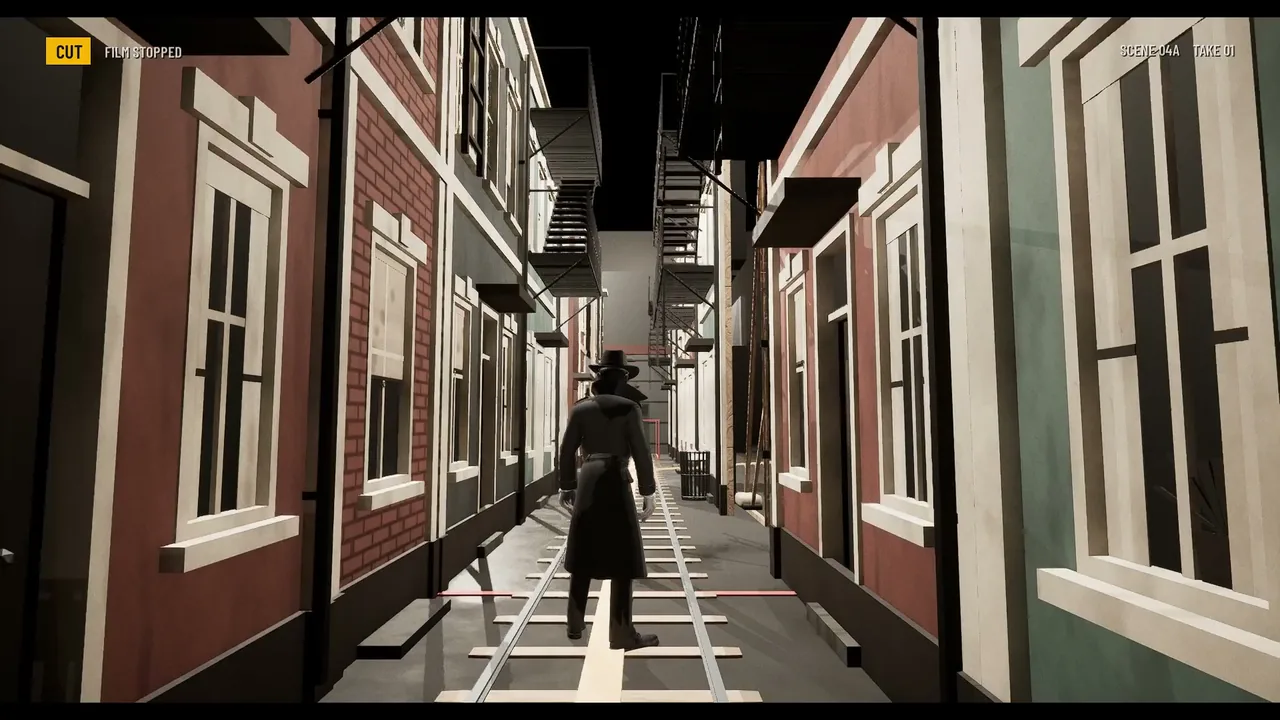
- Scene 04 — The Leap, in three parts: 4A Alley, 4B Warehouse and 4C Rooftops.
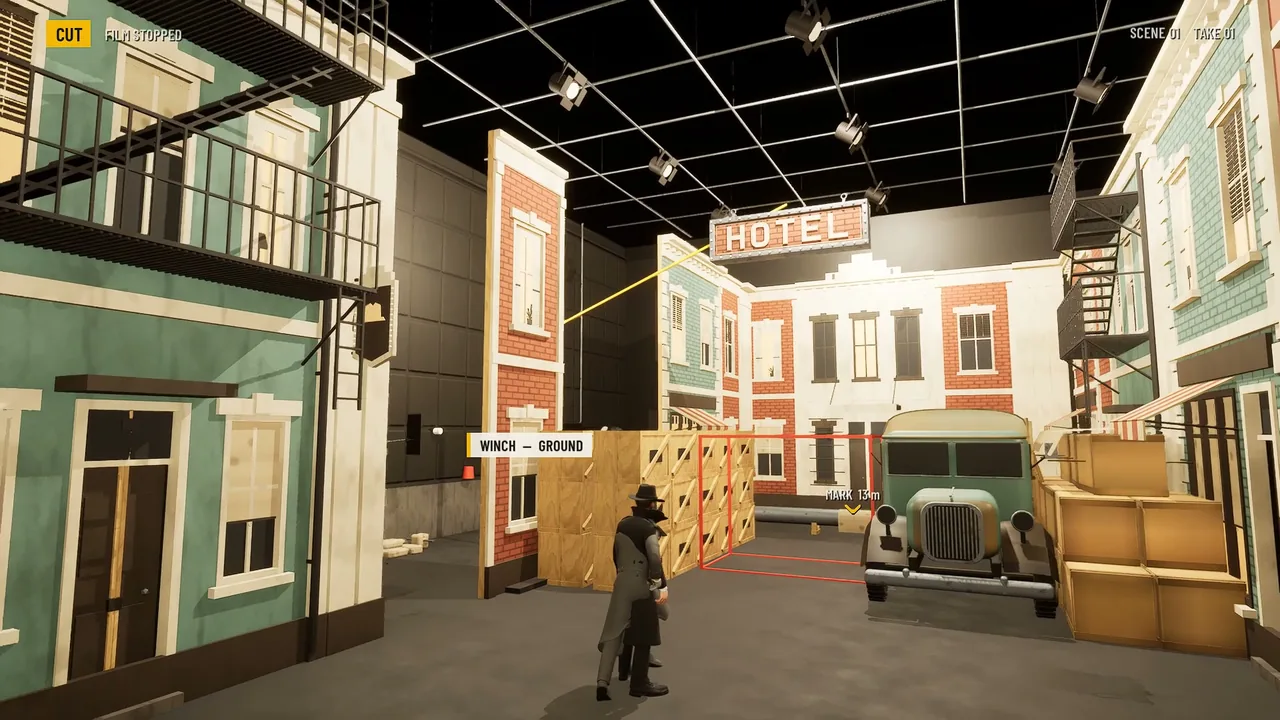 01CUT
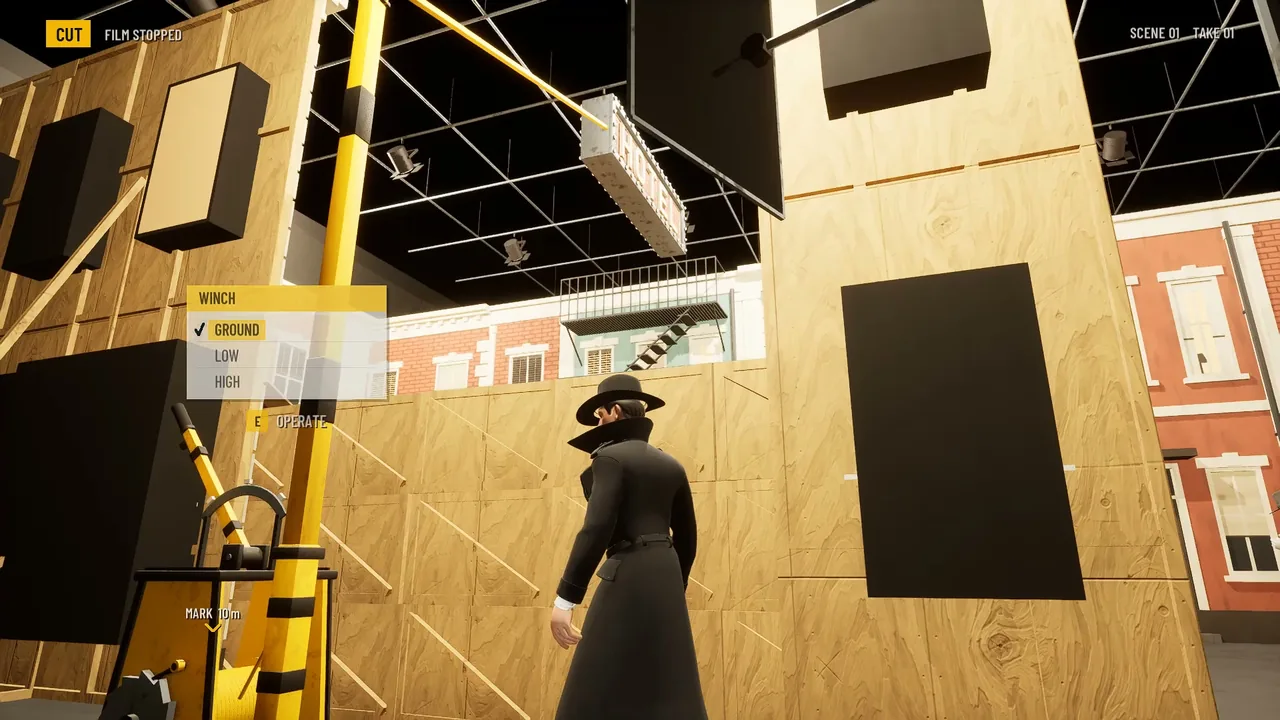 02CUT
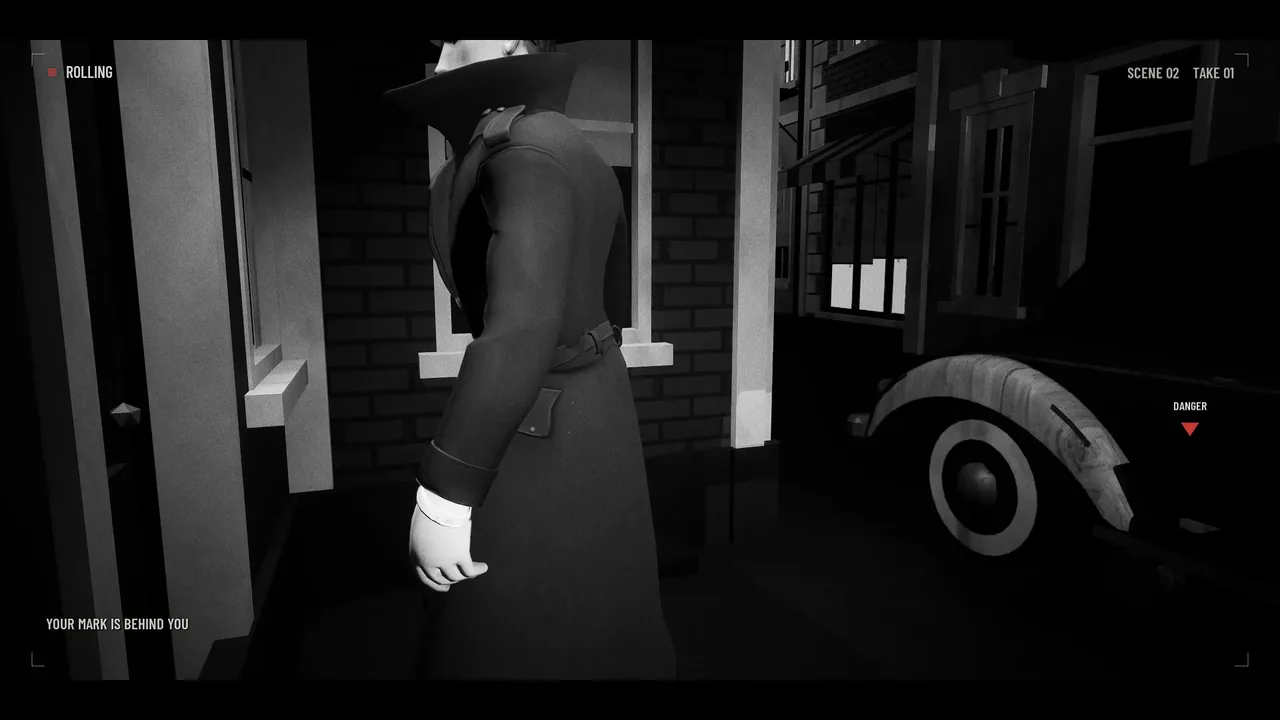 01ACTION
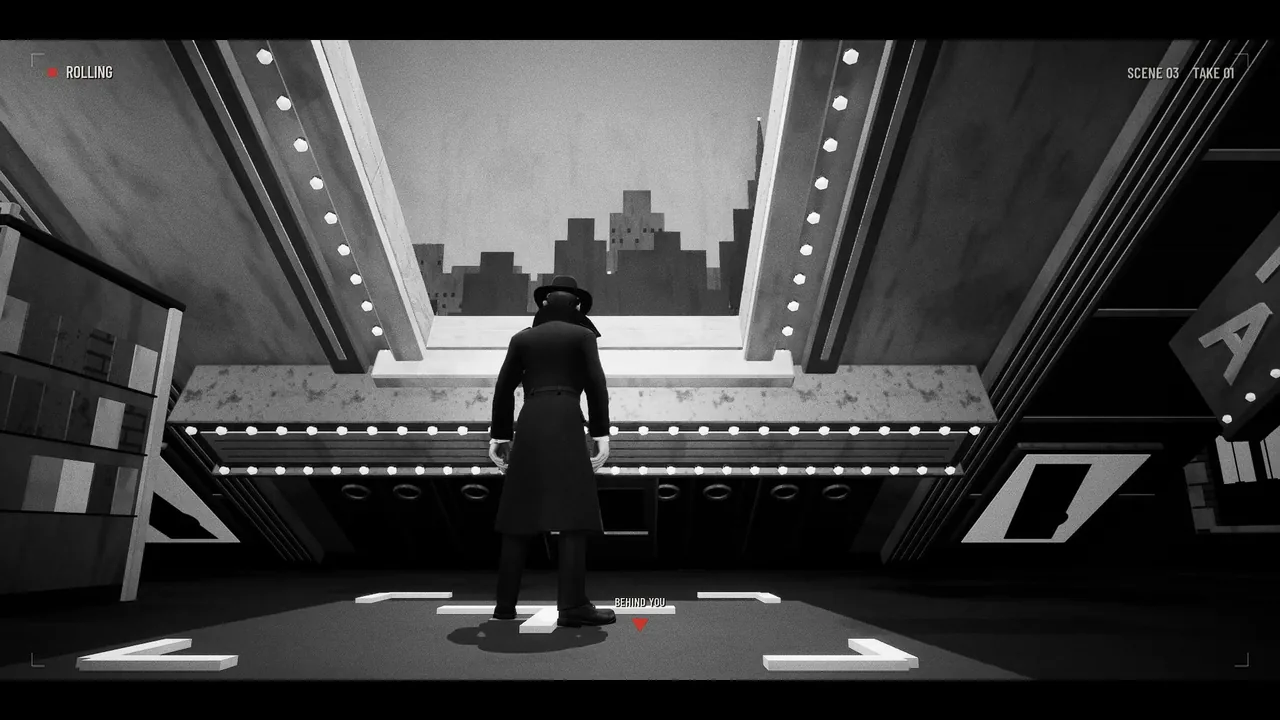 02ACTION
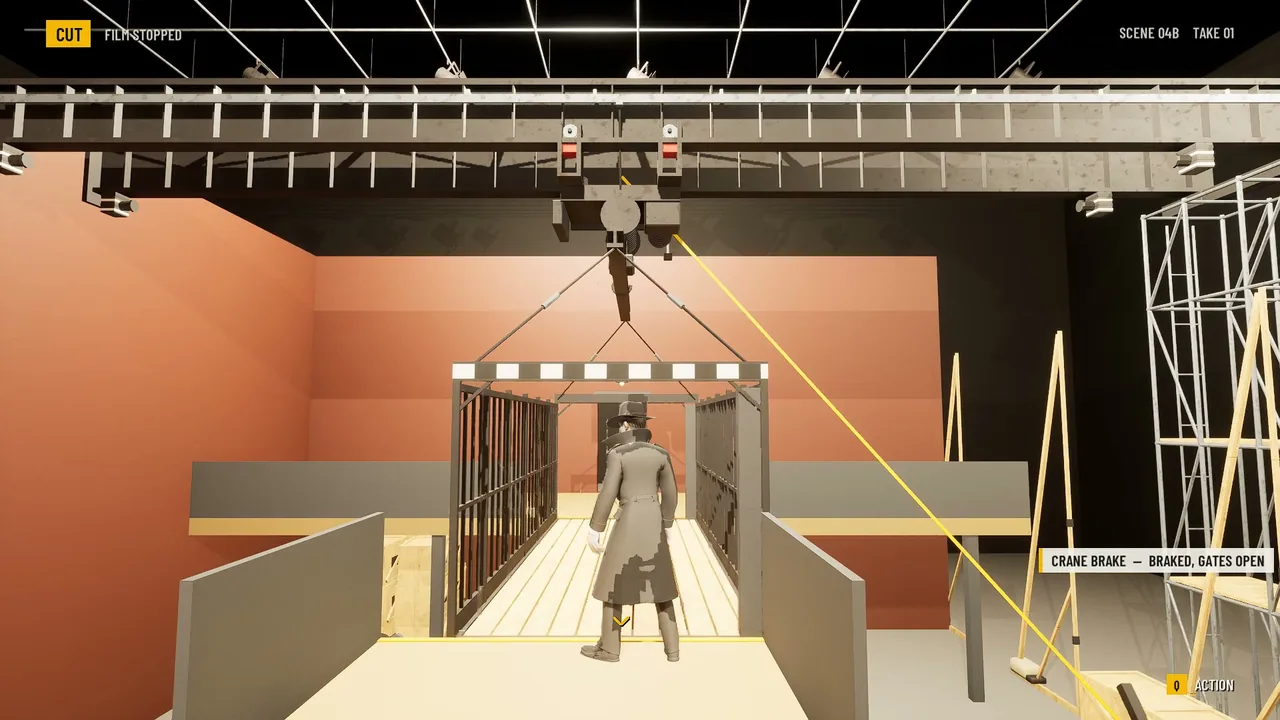
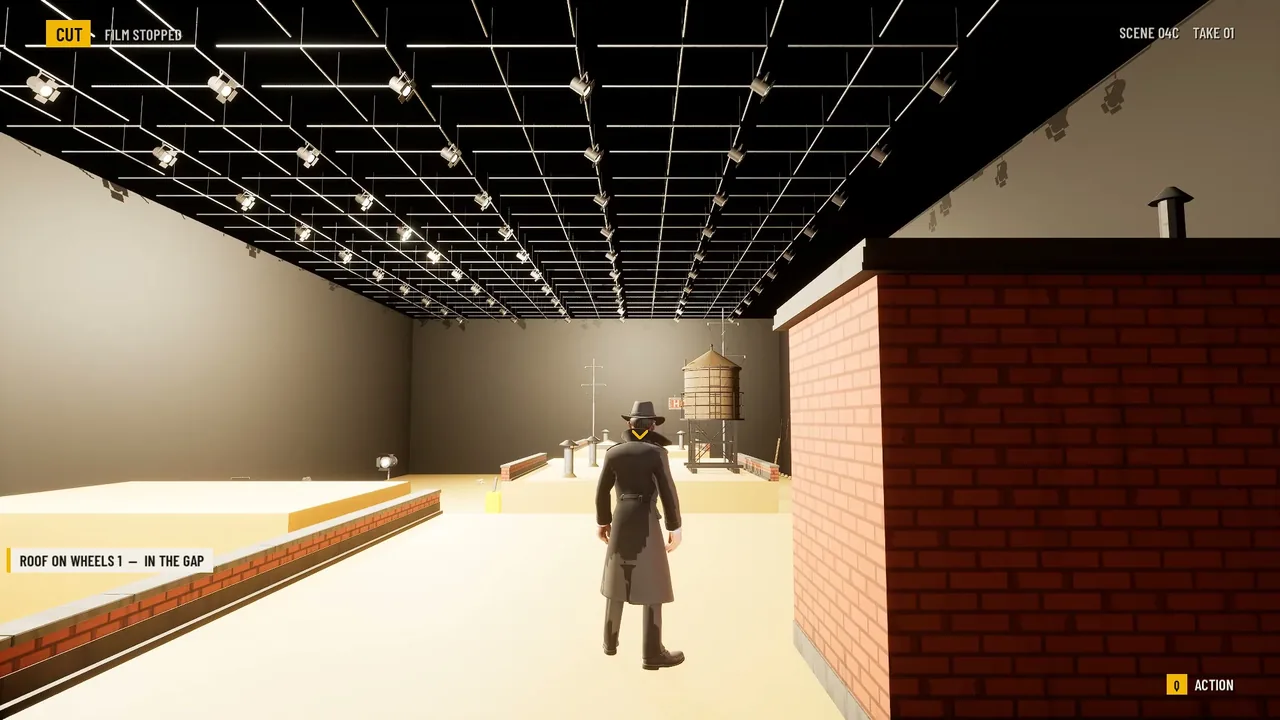
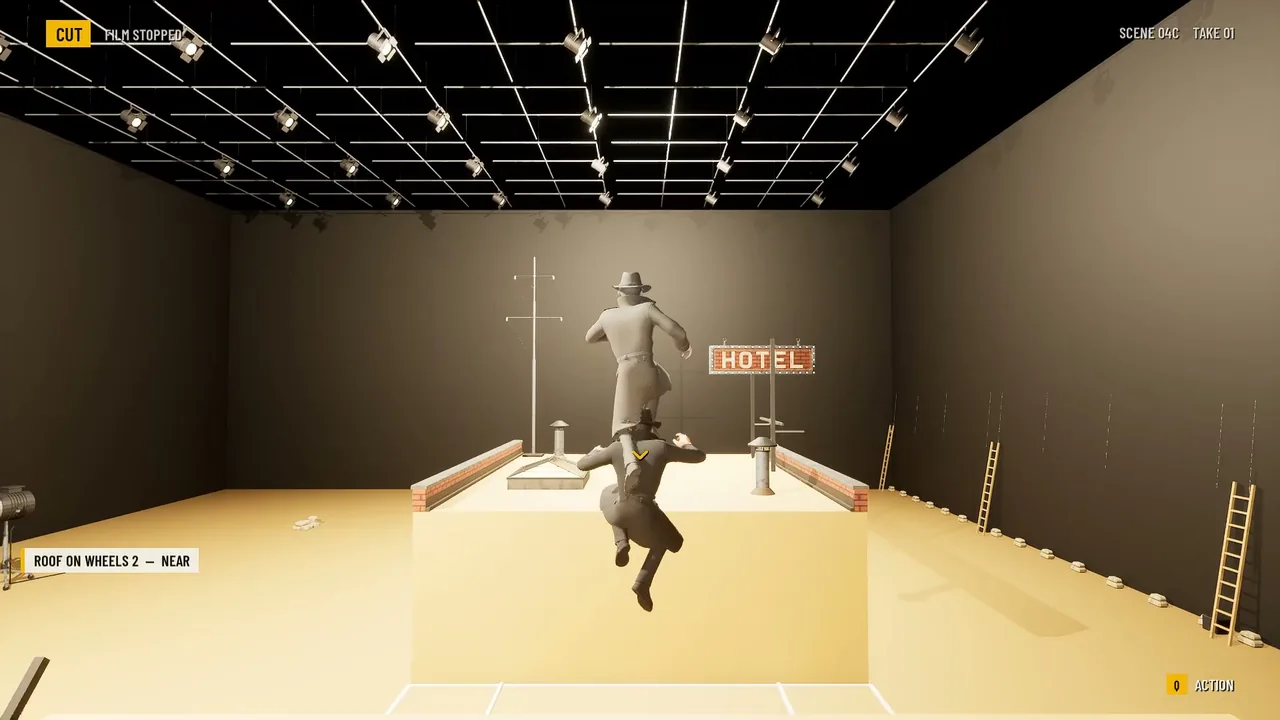
The fourth scene is the one the game was building towards. In 4A a breakaway panel in the alley only gives way to an actor at full speed. In 4B a warehouse crane runs on the scene clock, and its brake is the only way across. In 4C you call CUT in the middle of a leap: the actor freezes over the drop, and you walk out across the stage to move a whole roof on wheels under the place where he will come down.
 01CUT
 02CUT
 01CUT
 02CUT
The last gameplay fixes#
The last rule changes came from a person, not from a test. Scripted runs had passed Scene 4 from end to end. Then the developer played it for the first time, on the afternoon of 14 November, and found two ways around it:
- in the warehouse, the crane's walkway could be crossed without braking — wait until it lines up, and run;
- on the rooftops, the first moving roof could be skipped with a diagonal hop to the roof beside it.
The lead agent first wrote both shortcuts as scripts and ran them; both printed the shot, so both were real. The fixes went into the geometry rather than into new rules: the walkway became a cage whose gates open only when the crane is braked, and the first roof parks further away than the actor can jump. Both shortcut scripts now fail, the intended solutions still pass — 12 of 12 in the editor, 6 of 6 in the packaged build — and the developer played the fixes and approved them that evening. Day 3 has the details.
Art and sound#
Every set in the game is built twice. The greybox — the plain boxes the rules were tested on — is still the collision. The art hangs over it and never decides where the actor can stand. That split is what let art arrive late without breaking the puzzles.
Sets and props. Agent 02 (art) built the props, the façades, the world beyond the street, the Scene 4 warehouse and rooftops, and the newsstand that tears apart, in Blender, driven by script. The lead agent imported them, hung them over the greybox, and checked them in the game.
The detective. The developer generated the base model with Tripo AI. The art agent cleaned it up and redrew the face in Blender. In the game it is a costume: it copies, bone by bone, the pose of the engine's mannequin, which is the real actor.
Surfaces and light. The plywood of the studio started from one texture set made in PBRgen. The wet street — grain, puddles in bands, ripples and footprints — is generated by code, and it dries when you call CUT. The lights, the fixed film exposure, the dust and the debris are all functions of the scene clock, so they freeze with the film.
The two looks. In ACTION the film is black and white. In CUT colour comes back. The frozen actor becomes a silver stand-in, a copy of the film frame.
Sound. Agent 03 (audio) made the sound effects and the score with ElevenLabs, and processed them in FFmpeg. The lead agent wired them into the game by event. Film sound only exists while the camera rolls: on CUT it freezes with the picture, and the ACTION music stops like tape.
- Footsteps follow the pose — a step when the ball of a foot comes down — on wet street, in puddles, and on the dry studio floor in CUT.
- The score: a main theme, an ACTION loop, and short cues for a printed take and for the wrap.
- Scene 4's sixteen sounds were cut from sound already approved for the project, plus simple synthesis.
What a person has judged, and what not. The developer chose the pallet's crash by ear and approved the gameplay video with the game's own sound. There is no record of a dedicated listening pass of every sound inside the game, and none of a complete playthrough of all four scenes by a person. Neither is claimed here.
15 November, hour by hour#
Picture lock#
There are no commits to the game on 15 November before the video work. The build in the ZIP is the one packaged and tested on the night of 14 November: Shipping, English only, the four-scene production. Nothing in it was changed after that.
Recording the real game#
The developer asked for a gameplay video of 30 to 60 seconds, recorded from the real executable. The lead agent ran the game's own scripted runs — the full production, and the Scene 4 solution — from the Shipping build of the candidate ZIP, in real time and in full screen.
- The picture was captured with FFmpeg.
- The sound came only from the game's process, through a small local recorder written for the purpose, so no other sound from the computer could get in.
The first edit was 47.9 seconds at 60 fps. Validation found no errors, no silence, and no frozen picture except under the title. But no person had watched it yet.
The stutter only the camera saw#
The developer watched it and saw parts that stuttered. They also pointed out that playing the game by hand doesn't stutter. Both were right.
The cause was the test harness, not the game. The scripted runs save a screenshot at every event, and each one freezes the game for about a tenth of a second. The times of the screenshot files matched the stutters one by one — four screenshots and four stutters as the cinema front falls, four and four at the door. On top of that, capturing at 60 fps without vsync on a fast monitor dropped 5 to 12% of the frames.
The re-recording didn't touch the game:
- the second monitor, vsync at 30 fps and a fixed time step, so the game's clock stops while a screenshot is saved and the frozen frames become exact copies;
- a script removed those copies — 194 frames, 6.5 seconds, with the same stretch of sound — and corrected the recorder's 74 ms of delay.
The new cut is 44.3 seconds, 1080p30, the same 17 takes from a single recording. At 19:16 the developer watched it and approved it, then uploaded it to YouTube.
Three small glitches were seen in the scripted runs during capture and are not fixed:
- in a mid-air CUT on the rooftops, the camera can pass through the scenery for about two seconds;
- one frame of the CUT image can flash during the return to ACTION;
- on a print in Scene 3, one frame can jump back to the previous camera.
They're on the list for after the jam.
Choosing the cut#
There were two candidate ZIPs from the night before. The second one adds the opening card and the credits. The developer chose the second. The first is kept, untouched, next to it.
A name on the box#
The project files still carry the working title, Between Takes. The developer asked that the player shouldn't see it. Renaming the project would have meant recompiling the game on the last day, so only what a player sees changed.
- What changed: the launcher in the ZIP is now
RetakeTheory.exe; the two.batlaunchers and the README point to it; the game's window already said Retake Theory. - What kept the old name: the folder inside the ZIP and the inner executable. The engine finds its content by the project's name.
- The game files are byte-for-byte the ones in the chosen candidate.
- The test: the new ZIP was extracted into an empty folder and opened through the new launcher. Two scripted runs passed from there: the opening and a scene.
A page for the film#
The lead agent prepared the game's page on itch.io as a draft:
- the description in English, the controls, and how to install;
- the gameplay video;
- eight screenshots, all frames from the final video;
- the AI disclosure (graphics, sound, text and code);
- as the cover, the key art approved on Day 2 — promotional art made in Blender, not a screenshot.
Uploading the 369 MB ZIP and making the page public were left to the developer.
At 20:00, while this page was being written, the page opened without logging in, with the Windows ZIP attached: smallmythgames.itch.io/retake-theory.
Submitted#
At about 21:02 BRT the developer submitted RETAKE THEORY to the Epic AI MegaJam 2026, with the 369 MB ZIP, the gameplay video and this devlog. That was nearly two hours before the 22:59 deadline. A person sent it, as the jam's rules require; no agent pressed that button. The entry is public: itch.io/jam/2026-epic-ai-megajam/rate/5375896.
(Added after publication, 15 November, about 21:15.)
Where it stands, 15 November, 20:00#
| Item | Status |
|---|---|
| The game | Four scenes, the fourth in three parts. Shipping build, English only. Not changed after 14 November |
| Windows ZIP | SmallMythGames_RetakeTheory.zip, 369 MB (386,998,086 bytes). One folder, no debug symbols, no logs. Extracted and run by script from the ZIP itself, on the development machine. Not tested on another computer |
| Gameplay video | 44.3 s, 1080p, from the Shipping executable. Approved by the developer; on YouTube, opens without logging in |
| itch.io page | Public at the time of writing, with the ZIP, the video and eight screenshots |
| A complete playthrough of all four scenes by a person | Not recorded |
| Jam submission | Submitted by the developer at about 21:02 BRT on 15 November, as the rules require — the entry |
Who did what (Glass Box)#
The game had one human developer and five agent roles. They were roles, not five permanent programs: a main session ran the whole time, and the others opened for a batch of work and closed when they delivered. Only the lead agent ever opened the Unreal editor, compiled, imported or packaged. The specialists delivered files and a written handoff, and the lead agent checked and integrated them.
| Who | Role | Over the four days |
|---|---|---|
| The developer | Director | The concept and the title. Every scope decision. The playtests, and the shortcuts they found. Approving or turning down deliveries. The detective's base model, the logo, the video's approval, the choice of ZIP, the uploads and the submission |
| Agent 01 | Development, integration and testing | All the C++ code and scripts, the scene greyboxes, integrating art and sound, the automated tests and scripted runs, the builds and the ZIP, the gameplay video and the itch.io draft |
| Agent 02 | 3D art and visual assets | Props, façades, the world pack, the Scene 4 sets, the animations, the newsstand's destruction, the clean-up of the detective; the key art (promotional, outside the game) |
| Agent 03 | Music and sound design | The sound effects, the footsteps, the score and the Scene 4 sounds, with provenance and credits logged for each file |
| Agent 04 | Game design reviews and proposals | Scene reviews against the design, the post-mortem of the rejected fourth scene, three new concepts, and the choice of THE LEAP |
| Agent 05 | Documentation and this devlog | The public log, written from the project's logs, decisions and captures |
What the developer turned down or changed — the part of the record a finished game hides:
- The first fourth scene, Round the Block: not approved. The design agent's post-mortem and three new concepts led to THE LEAP.
- The second version of the destructible newsstand: rejected. The third went in.
- Scene 4: two shortcuts found in the first playtest. They were closed before the scene went into the production.
- The working title: Between Takes became Retake Theory, with a new logo the developer made.
- The first gameplay video: sent back for its stutter.
- The ZIP: the developer chose the second candidate over the first, and asked for the working title to come off what a player sees.
The tools (Glass Box)#
Only tools actually used, from the project's asset and tool register. "In the game" means it is in the ZIP.
| Tool | What for | In the game? |
|---|---|---|
| Claude Code (Anthropic) — Claude Fable 5.2 and Claude Opus 5.5 for most of the work, Claude Sonnet 5.5 and Claude Haiku 5.5 in part | Every agent: the code, the tests, the builds, the art and audio scripts, the design reviews, the documents and this log. Its browser tools were used for the PBRgen web interface and the itch.io draft | Yes — all the code |
| Unreal Engine 5.8.4 | The engine, with Python editor scripts for imports and materials | Yes |
| Blender | Every prop, set and animation of the art agent, made by script; the clean-up of the detective; the key art | Yes (the key art is promotional, not in the game) |
| Tripo AI | The detective's base model, generated by the developer | Yes — the actor's costume |
| PBRgen | One plywood texture set, the base of the studio plywood | Yes |
| ElevenLabs — sound effects and music | The game's sound effects and its score. Also one music track for promotional material | Yes (the promotional track is not in the game) |
| ChatGPT | The RETAKE THEORY logo, made by the developer | Yes — the title logo |
| OpenAI image generation (through the Codex CLI) | One film-dust texture, used only on the key art and in promotional video | No |
| FFmpeg | Processing the sound; capturing and editing the gameplay video | No (tool only) |
| HyperFrames | Rendering a promotional video from HTML | No |
| Python | Generating the street textures; build, test and image scripts | Code-generated textures, yes |
| Visual Studio's C++ compiler, Git | Compiling and version control | No (tools only) |
Two corrections on this page:
- Day 1 says Tripo AI was tried and isn't in the build. That was true on 12 November. From Day 2 on, the detective in the game is built on that model.
- The developer also used ChatGPT to think through plans and direction. That shaped decisions, but it didn't generate the game's assets. The only game asset made with it is the logo.
What we learned#
Scripts prove rules; people find the game. The last full regression passed 17 of 17 automated tests, 32 of 32 scripted runs and 40 of 40 runs in the packaged build. Those runs proved that every scene can be printed, that sound never plays in CUT, and that nothing crashes with garbage collection forced every frame. They did not find the two shortcuts in Scene 4 — the developer found both on a first playtest. Nor did they see the stutter in the video: it came from the scripts' own screenshots, and only a person watching noticed. Tests tell you the game obeys its rules. Only a person can say whether those are the right rules.
Keep every checkpoint. Every risky change shipped with a switch to undo it:
- the three-scene production;
- the greybox of Scene 4;
- the old newsstand;
- the music off.
Every candidate ZIP was kept intact next to the next one. On the last day, that meant every decision could be reversed in minutes, and so it could be made in minutes.
Agents need lanes. One agent owned the editor; the others delivered files and handoffs. Some conflicts still got through. This log's own branch couldn't merge the main line on the last night, so it read the captures from the main checkout instead of forcing the merge. Without those lanes, five roles working in parallel on one Unreal project would have overwritten each other.
Time shaped the design as much as ideas did. The fourth scene was chosen with an honest estimate of the hours it would take. Its checkpoints reuse something the game already did — chaining scenes — instead of a new system. On the last day the name on the box changed without recompiling, because a recompile was the one risk not worth taking.
One deep verb. The game never got a second mechanic. Each scene asks the same question — what do you change when the film stops? — in a new place. Scene 4 asks it in the middle of a jump. Refining the one system, rather than adding new ones, is why a fourth scene was possible on the third day.
The final cut#
Four days ago, this was a concept on a page. Today it's a playable noir film where stopping the camera lets you rewrite what happens next. It is a small game, made in a hurry, with rough edges we know about and some we don't yet. It has been submitted; what happens next is up to the players and the jury.
Thank you to everyone who followed this log.
Play RETAKE THEORY: smallmythgames.itch.io/retake-theory · Watch the gameplay: youtu.be/7Spytgoc6ls
RETAKE THEORY was made by Small Myth Games for the Epic AI MegaJam 2026 (theme: Director's Cut).