

Day 2 began at midnight with a change of priorities and ended just before midnight with the new run, the car hit and the original score finally in the game. In between: Scenes 2 and 3 dressed as a film set, a new name, a redesign that says less, a street rebuilt, a city behind the windows, a second language, and a first look at a fourth scene.
This day was first published as separate chapters, one for each part of the day. They are joined here, in the order the work happened.
Night, 13 November#
At midnight the developer changed the order of priorities. The rules were holding in every scripted run; the biggest risk to the game was now how it looked. Visual work would go ahead of tests and documents, with a full regression only at each visual milestone, and the agents could make visual changes within the art direction without asking first.
By 05:30 the game had a different face — and a new name.
Scenes 2 and 3 get dressed#
Scenes 2 and 3 had been grey boxes. The lead agent dressed them with the Scene 1 facade kit, repainted per module, plus painted backdrops, studio walls, the lighting grid, braces, lamps and crates. The grey boxes stay in place as the collision; they are no longer drawn, but they still cast the shadows.
The art agent's Lot C went in at the same time — twelve props made by script in Blender: a sedan for the car on rails, track and sleepers, the barricade (whole and broken), the pallet and its debris, a newsstand, a lamppost, a hydrant, a bin, a bench.
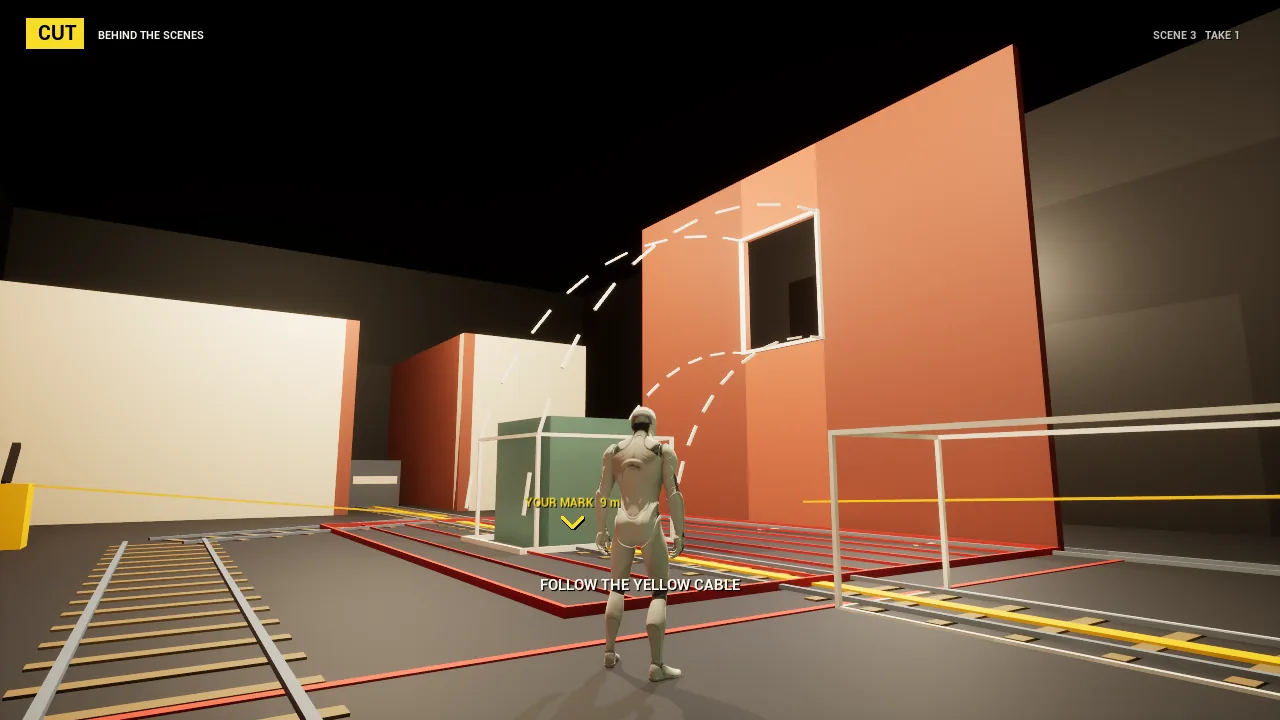 01CUT
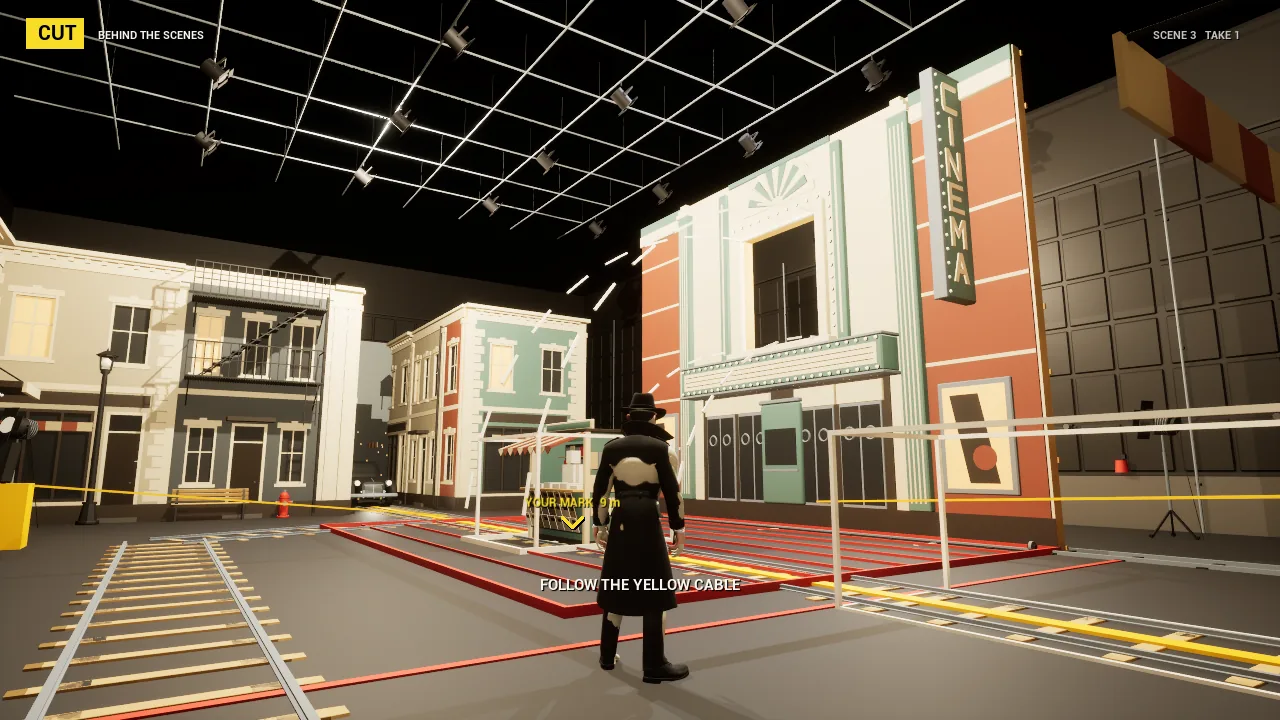 02CUT
The detective. The developer had generated a noir detective with Tripo AI; the art agent cleaned it up in Blender. It goes on as a costume: a mesh that copies the mannequin's pose bone by bone, 190 cm to the top of the hat. Animations and collision didn't change. Two bugs on the way — the costume stuck in a T-pose, then vanished (the file had a 100× scale on its root bone) — were fixed before it went into the default build.
A new HUD replaced the prototype text, and the debug line in the corner is now off by default.
Fixed along the way: the shadow-map warning came back when Scene 2 was dressed (same fix as before), the HUD drew no text at all (the canvas needs a font asset), and a bin stood in front of the camera at the end of Scene 2.
Dust, and a failure card that keeps the answer to itself#
- Dust: nineteen soft puffs along the fallen cinema front, growing and fading in two seconds — driven by the scene clock, so they freeze with the film.
- Correction 04: the art agent rebuilt twenty in-game models to stop the flicker the developer had spotted (z-fighting). They were re-imported over the old ones, with the same names and pivots.
- Two more facade lots (D and E) were imported behind a switch. They are not the default: the build ships shortcuts to compare them.
Then the developer said the Scene 3 failure screen explained too much. The rule became: the screen explains the rule, not the solution.
- The diagram card from the evening is gone. The slate now states the shot in one line, on the first take only.
- Missing the shot says
CUT!,YOU WERE OUT OF FRAME,BACK TO ONE— and nothing else. - Hints exist, but only on request (the
Hkey): one for every two takes without a print, three per scene at most. - Prompts and messages moved to the bottom-right corner, never over the actor.
A full regression closed the milestone: 15/15 tests, 28/28 scripted runs, 38/38 in the packaged build. The logs then showed one material missing a flag on the studio lamps; it was set and the build was repackaged and re-checked.
RETAKE THEORY#
A third playtest by the developer brought three notes:
- the car's alternative route seemed to end against a house;
- in CUT, the white mannequin left on your mark clashed with the detective;
- the interface still looked like a prototype.
And a new public title: RETAKE THEORY. The project files keep the working name, Between Takes. The developer made the new logo with ChatGPT; its files arrived at 02:26 that night.
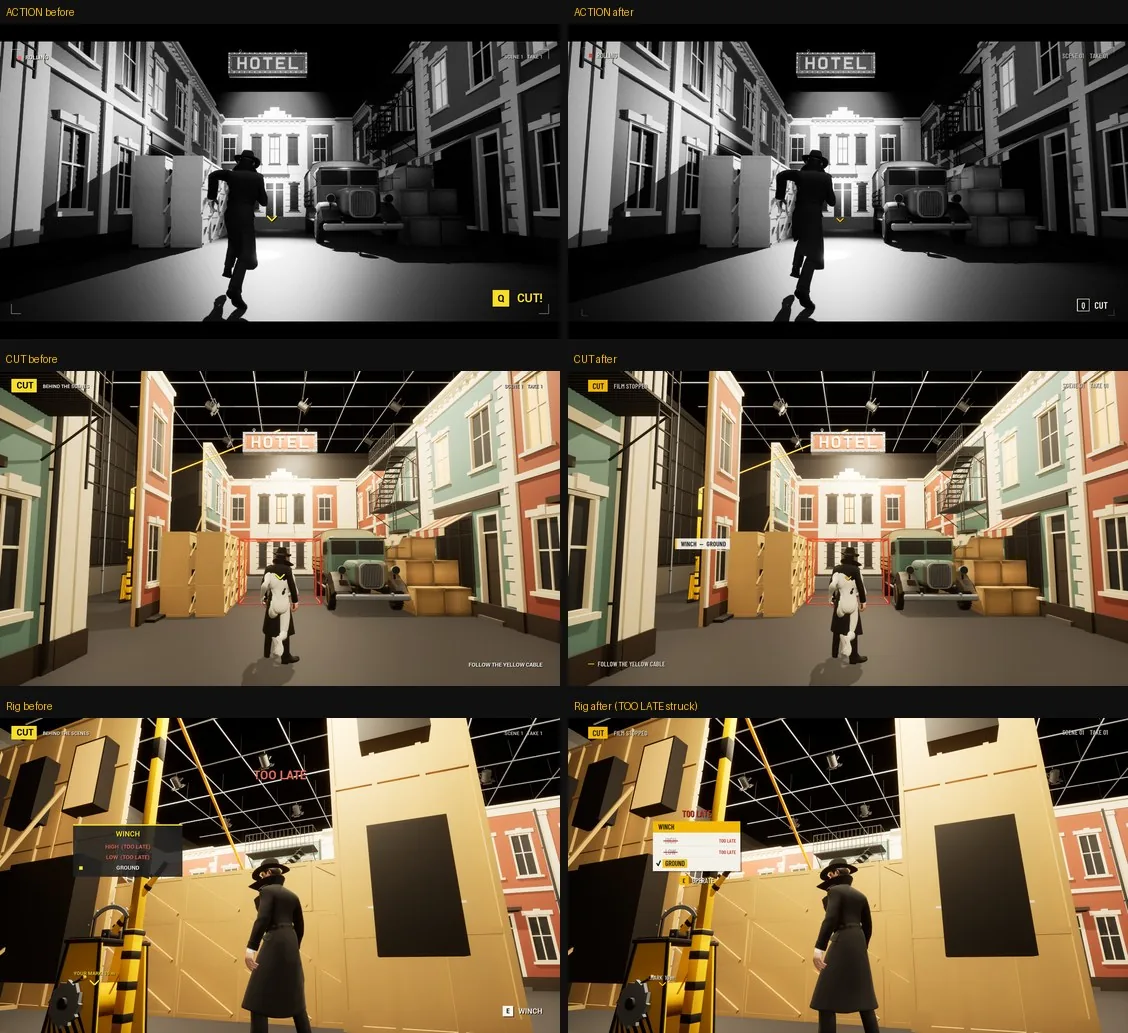
The interface became production paperwork, drawn by the game:
- a slate with clapper stripes;
- yellow CUT tape, and tape labels over each rig;
- a paper card for the rig you walk up to, with the current setting highlighted and past ones struck through in red: TOO LATE;
- a CUT! card in the lower-left third, That's a Print and That's a Wrap with the take count.
In ACTION, almost nothing: ROLLING, scene and take, your mark, and the first CUT prompt. Two open-licence typefaces carry it (Cormorant SC and Barlow Condensed, both SIL Open Font License).
One finding explained a lot: the palette colours had been written as linear values. That is why every dark box came out grey and the yellow came out lime.
The stand-in is now the detective, frozen as a silver print of the exact frame you cut on, instead of the plaster mannequin.
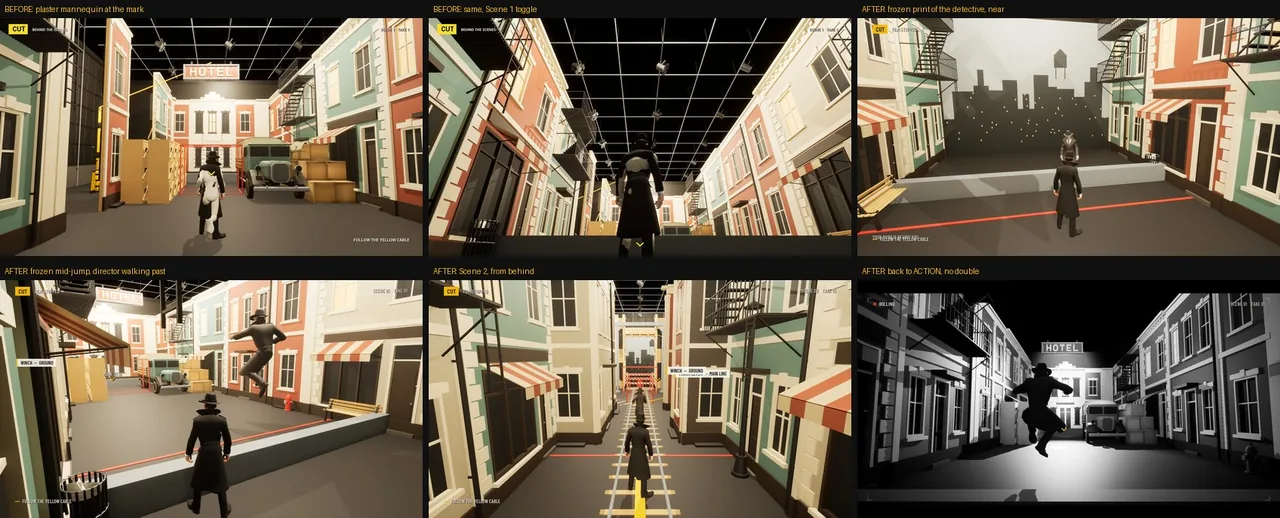
The car's other route now leaves the yard through a garage with a roll-up door. The door rises as the car comes in and drops on the scene clock. In CUT, the trick is visible: the rails, the car parked backstage, a striped barrier.
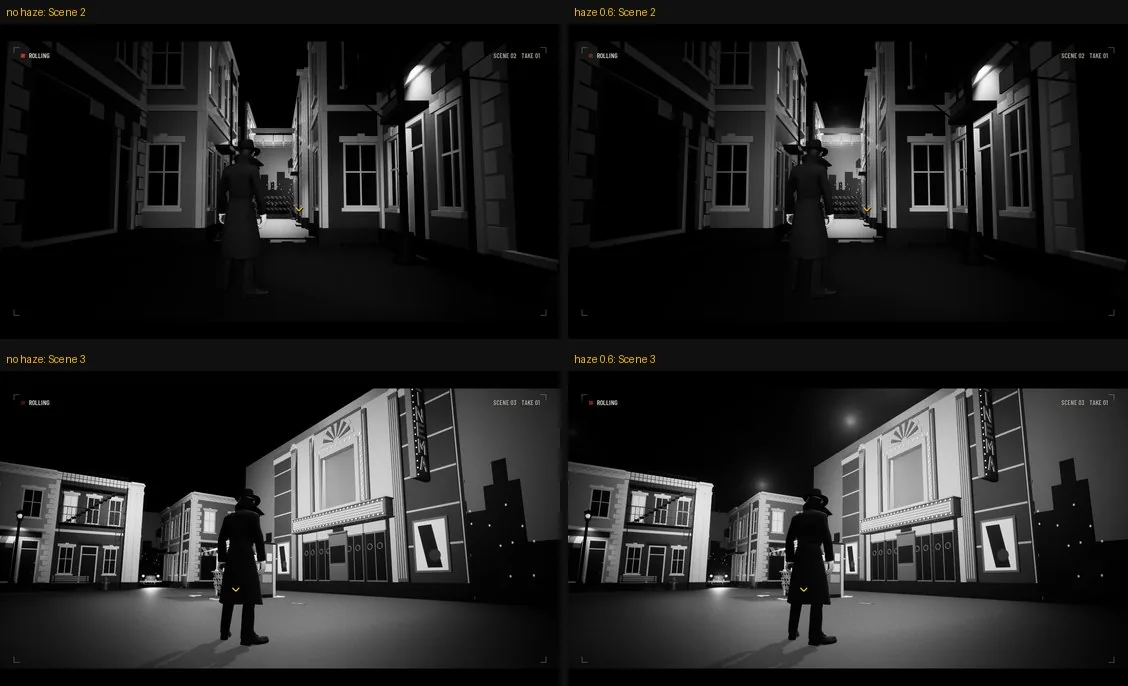
Atmosphere: volumetric haze, only on the film side, so the beams and lamps get halos and depth. Dust also drifts through the cinema front's window. Measured cost of the haze in an off-screen run: 0.05 to 0.4 ms per frame.

A known flaw stayed in: when the detective turns, the back leg passes a few centimetres through the coat. The art agent confirmed it is in the model, so fixing it means changing the coat — the developer had frozen the models.
Full regression: 15/15 tests, 28/28 and 19/19 scripted runs, 38/38 in the packaged build, then 8/8 more on the new stand-in and the garage.
Not proven, at 05:30: none of this had been played by a person.
Morning, 13 November#
The morning of Day 2 started with a bug the scripts had never looked for, and ended with the first real redesign of how the puzzles are presented. The theme of both: the game was telling the player too much in some places, and the wrong thing in others.
Playing it again, and a front door#
The developer finished the whole production, chose to play again — and the second run started wrong. The rigs were still where the first run had left them, Scene 2's car was already wrecked and its barricade broken, and in Scene 3 the actor spawned on top of the fallen cinema front, about nine metres up.
The lead agent wrote the reproduction before the fix: a scripted run that plays all three scenes, presses replay on the closing card, and plays again. Before the fix, it failed and listed everything the second production had inherited: three rigs out of place, the wrecked car, the broken barricade, the parked car and the fallen front in Scene 3, and three CUTs already counted.
There were two causes:
- "Play again" only reset the opening scene.
- When a take reset, the actor was placed on the mark before the set was put back. With the front still lying over the mark, it swallowed the actor and lifted them as it stood up. The same thing could happen on an ordinary retake.
The fix: a new production resets every scene — rigs back to how they were built, set pieces, takes and CUTs — and the set is posed before the actor. "Back to one" still keeps your rig settings, as it should.
The same session gave the game a front door:
- a main menu with the official RETAKE THEORY logo over a slow camera on the first street;
- pause on Esc;
- HOW TO PLAY and SETTINGS;
- on the closing card: SHOOT IT AGAIN, MAIN MENU, QUIT, with the total number of takes.
Menus pause the world, and a script checks that the scene clock doesn't move while they are open.
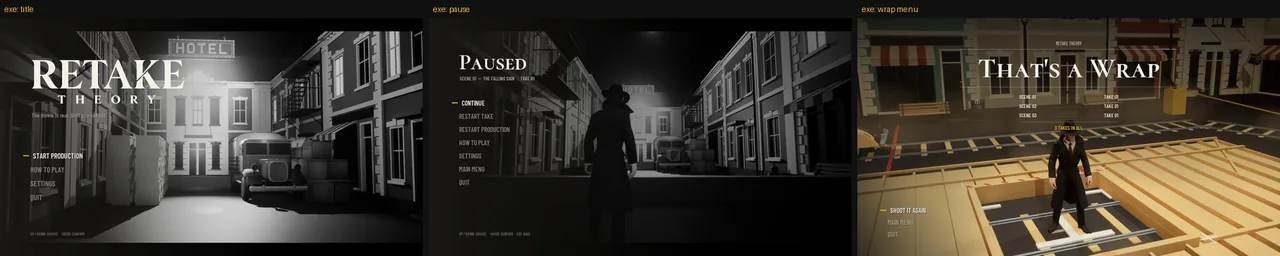
Full regression: 15/15 tests, 30/30 and 19/19 scripted runs, 40/40 in the packaged build.
Gameplay 2.0: say less, show more#
The developer asked for a gameplay sprint and brought in another agent first. Agent 04, the level-design reviewer, audited the three puzzles and the progression. Some of its findings were uncomfortable. One sentence in our own design document turned out to be wrong: in Scene 2, simply repeating Scene 1's winning winch setting did win, without reading the track at all.
The developer approved some of the proposals, held others back as variants, and kept one as a study only:
The winch now steps up from the ground. The positions and the outcomes didn't change; what the first press shows did. Before, in Scene 2, the first press landed straight on a working answer. Now it lands on a setting that the chalk preview draws in red — so the first thing you see is why it fails, and the decision is yours.
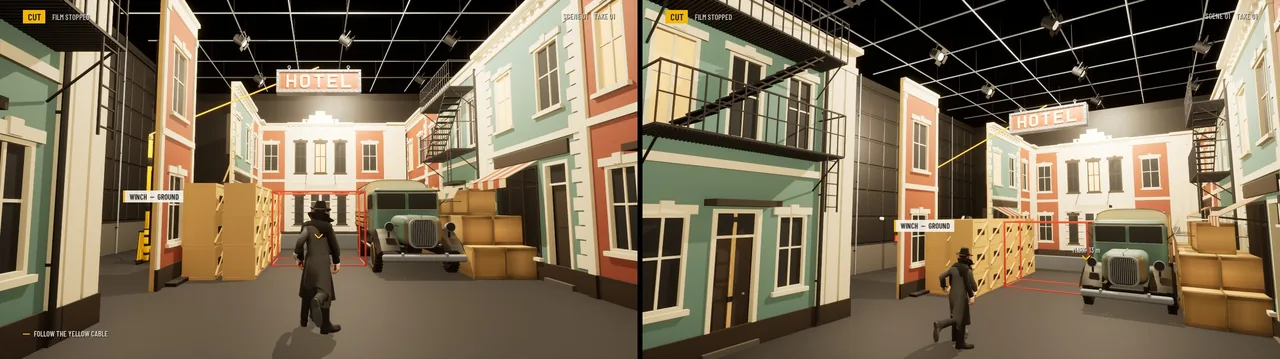
Scene 1's first CUT became a reveal:
- On the first take, the CUT prompt no longer flashes during the warning creak. It appears only when the sign lets go.
- On the first CUT of a production, the camera turns for about a second to the frozen sign, the cable and the winch, then pulls back. It never takes control away: moving the mouse hands the camera straight back.
- "Follow the yellow cable" only appears for a player still standing near the mark after six seconds.
 CUT
Two experiments the developer did not make the default:
- A longer approach in Scene 2 (a switch: 6 m more street before the chase). It was the playtest's complaint that the shelter came too early. The scripts confirmed the timing changed, and also that, on a first take, the falling pallet still catches a player who runs straight ahead before the car does.
- A study for Scene 3 with the car's alternative route passing right next to the safe spot. The first version of the route failed its own sweep test: turning at the planned junction, the back of the car brushed the chalk area in 106 positions. The agent reproduced the problem outside the game with a small script, compared five trajectories, and kept the one that touched none. The captures also showed a risk that stayed open: from the player's camera, the passing car can hide the actor for almost a second.
Full regression on the default layout: 17/17 tests, 32/32 and 21/21 scripted runs, 40/40 in the packaged build, plus 6/6 runs of the variants in the packaged build.
Not proven: whether the reveal surprises, whether the longer street gives time to understand the car, whether the Scene 3 study feels risky. Nobody had played any of it yet.
Afternoon, 13 November#
The afternoon went to the surfaces: what the walls, the plywood and the street are made of, and what the city behind the windows looks like. Most of the art came from the art agent as Blender scripts and texture sets; the lead agent wired it into the game, measured it, and found what broke. The developer judged what stayed.
A material library, and plywood made with PBRgen#
Two deliveries from the art agent went in:
- BT-046, a surface library made by code, without generative AI: brick, plaster, wood, metal, asphalt — eleven textures, two master materials, nineteen variations. Each piece of art now reads its material by slot name; the colours still come from the art direction.
- The studio plywood. This is where the jam's PBRgen access was used: one texture set generated in PBRgen's web interface (18 credits), with the agent stopping before every button that spends credits. From it the agent built three hybrid strengths. The developer chose "balanced", with "subtle" as the fallback.
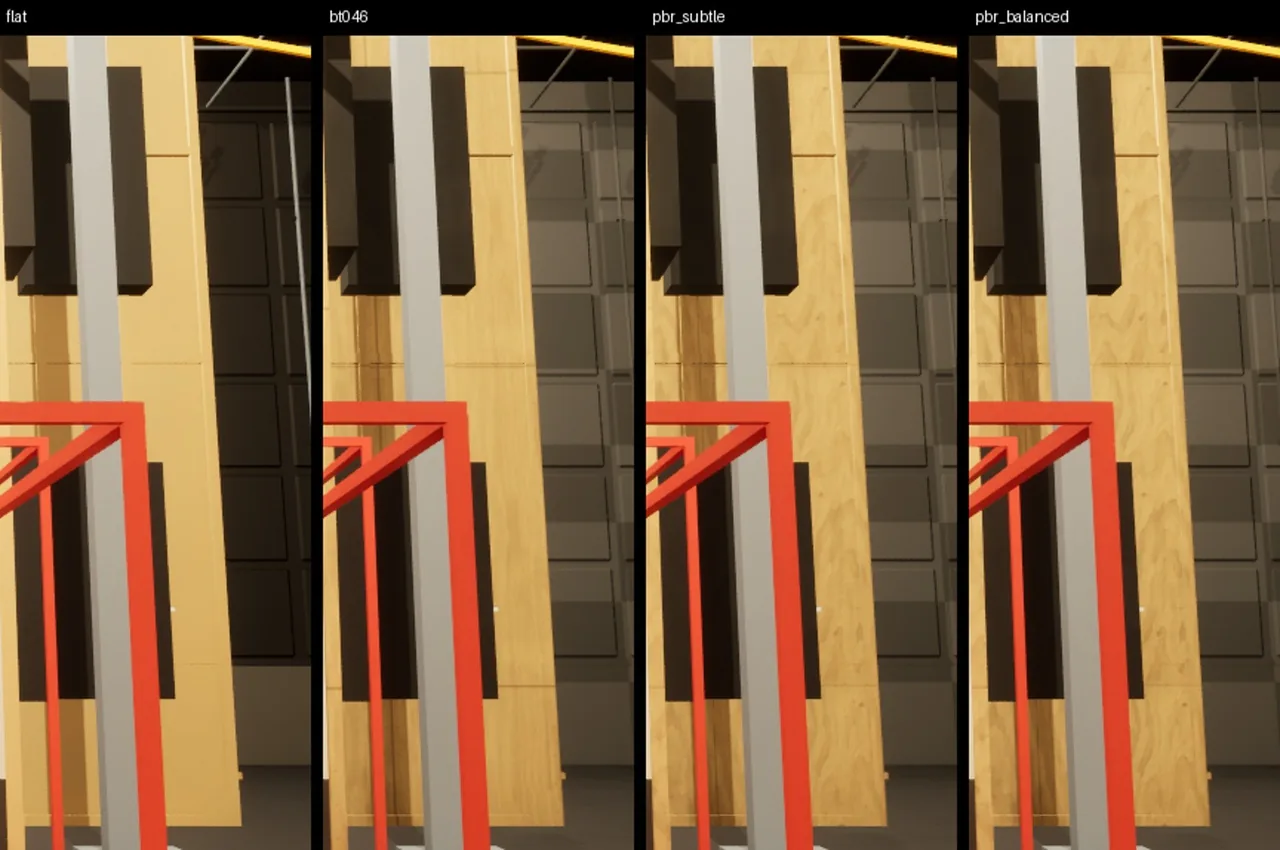
The agent's setup scripts ran inside Unreal for the first time and reported two failures that weren't failures: reading the values back showed everything had been applied, but Unreal 5.8 returns false from those calls anyway.
The captures found real problems, all fixed the same afternoon:
- The whole frame went darker. In Scene 1, the crates dropped from an average grey of 155 to 104, the floor from 114 to 70. The asphalt texture's tone channel averaged 0.14, leaving the floor at about a quarter of the approved colour. After recalibration: crates 151, floor 114.5.
- Studio walls, crates and sleepers came out checkered. The new materials lacked the flag Unreal needs for instanced meshes. It was set on all three masters.
- The studio black was too light in CUT and lost its dirt. It was retuned.
- A fragment of the cinema front flew at the camera and covered the actor. The fragments were made smaller and kept low.
That last item came with a new effect: debris and dust on impact for the cinema front, the sign, the pallet and the barricade, all driven by the scene clock, so they freeze in CUT like everything else.
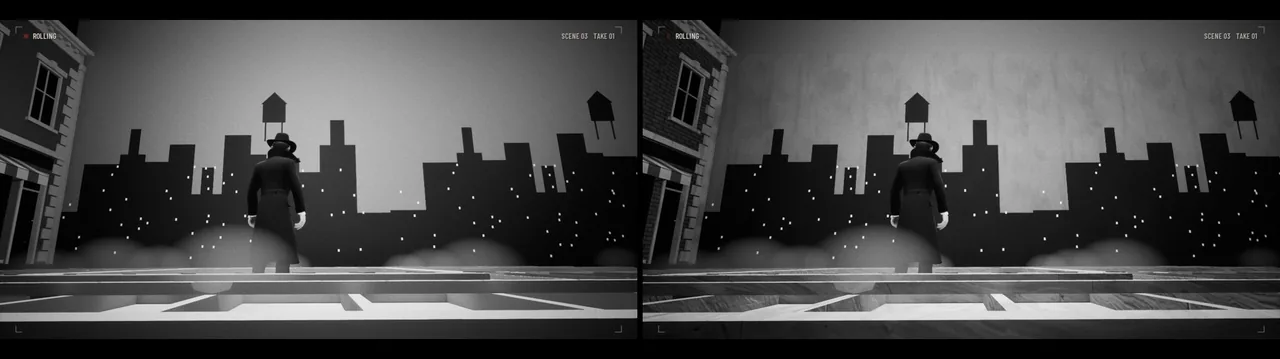
Full regression: 17/17 tests, 32/32 and 21/21 scripted runs, 40/40 in the packaged build. Frame cost in an off-screen run: no difference beyond the noise between runs (about 1 ms).
"It looks like plaster filler"#
The developer played with the puddle study switched on and didn't like either half of it: the street looked like smooth filler, and the puddles like mirrored stains stuck to the floor.
The lead agent measured before changing anything. The library's asphalt had no grain at all: its normal map was almost flat, and the street material didn't read it. The puddles were one smooth-edged blob repeated every four metres.
The rebuild, without generative AI:
- a script (Python and numpy) generates the asphalt's grain, mid noise, large tonal variation and patches, as tileable textures;
- a new street material blends dry, damp and wet bands, with organic puddle edges, and keeps CUT dry;
- three versions — A (current), B (grain only) and C (grain and puddles) — captured from the same cameras, with walking clips.
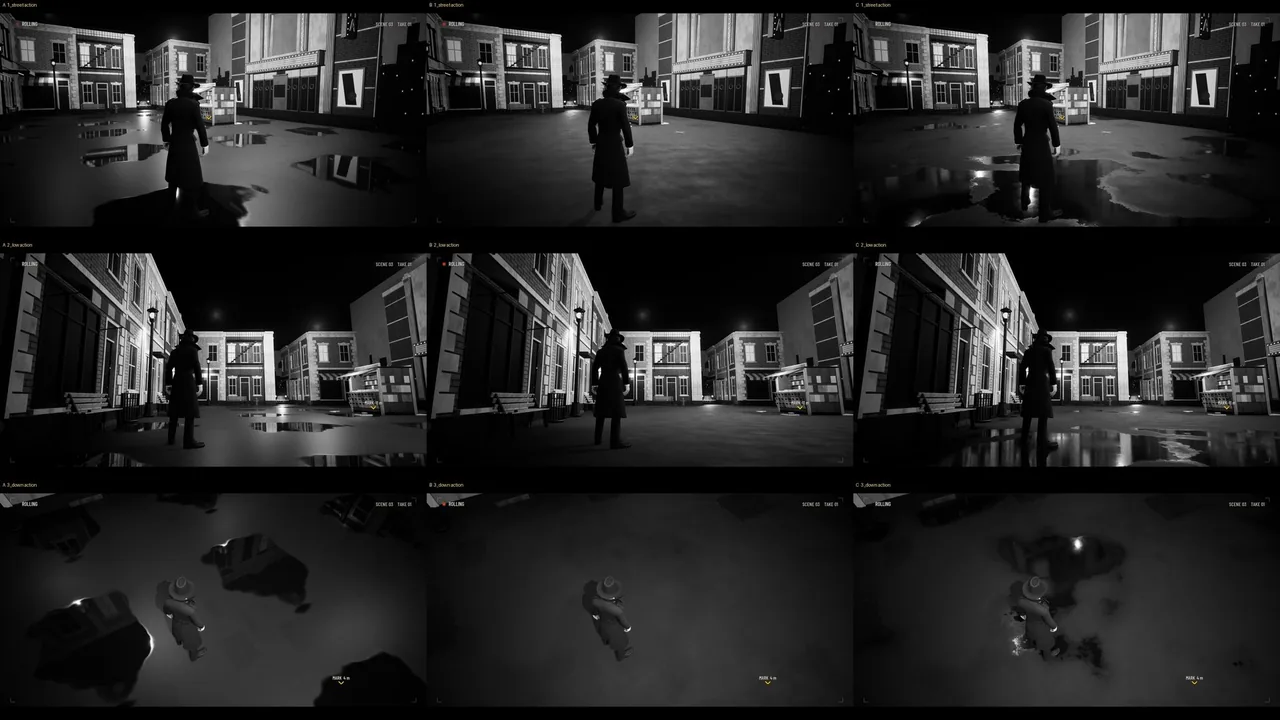 ACTION
Flicker was measured, too, as the frame-to-frame residual in the lower third of a walking clip: A 1.34, B 1.38, C 1.63. The grain doesn't flicker more than the old floor; C's extra comes from reflections that move with the camera.
Full regression with the old street still the default: 17/17, 32/32, 21/21, 40/40 in the packaged build.
Water that reacts#
The developer approved street C as the default, and asked for the water to react to the actor. Ripples and wet footprints are driven by the same water field as the material, so a print only appears where the street is actually wet.
Getting there took measurement:
- Steps. The foot "leaves the ground" earlier than expected: up to 10 cm in the air walking, 36 cm running. The thresholds were set from measurements, not guesses.
- Prints first came out sideways and 12 cm long (the decal's axes were swapped, then its toe was reversed). They are now 30 cm long.
- Ripples were invisible on water reflecting a black sky, and got a faint grey ring. For their first few frames after a material rebuild they render as boxes while the shader compiles — not a bug, and easy to mistake for one.
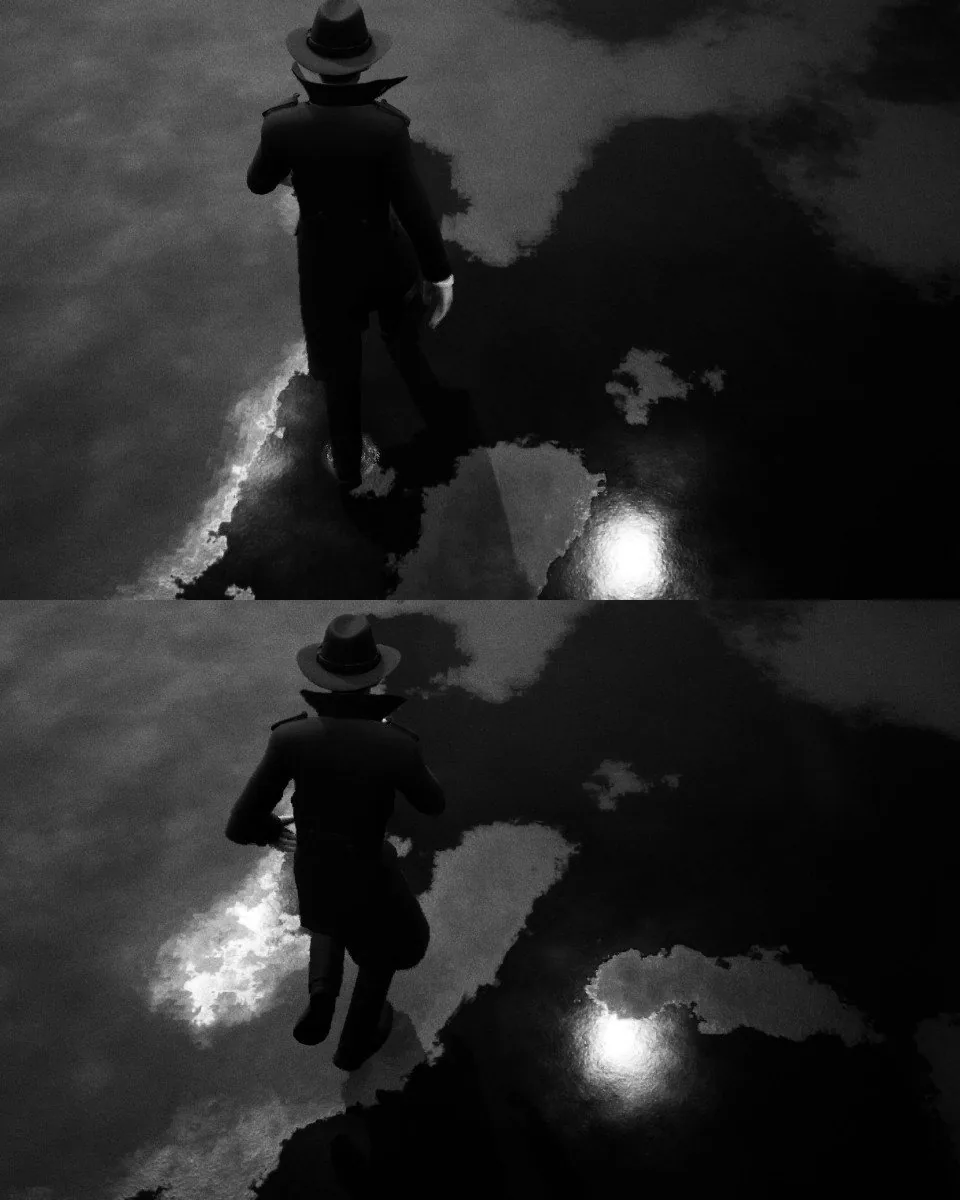
In the scripted run: two rings and five prints walking; none in CUT; the same five back when the film rolls again; none after a retake.
BT-WORLD-01: a city behind the windows#
The art agent's BT-WORLD-01 pack — 27 models made by script in Blender, without generative AI, zero credits — went in, scene by scene, behind a switch that turns it off. It adds:
- layered horizons;
- window grafts for the shop fronts;
- signs;
- film-set equipment.
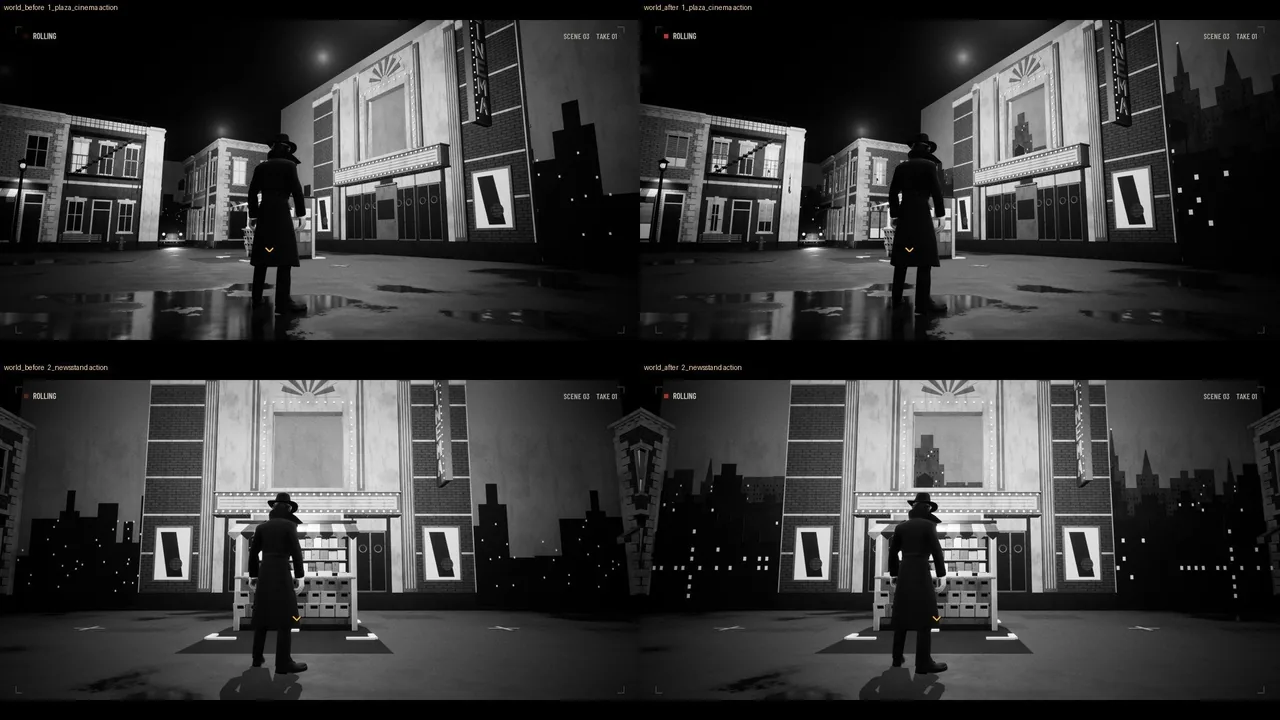 ACTION
In CUT, Scene 3's set gained a film camera on a tripod with sandbags, the large Fresnel lamps behind the cinema, and the flat that holds up the painted horizon.
What got worse or was left out: in Scene 2, seen from the barrier, the new eastern horizon reads darker and with fewer windows than the old one. Scene 2's own kit, its sign, Scene 1's cables and one older facade lot were held back.
Routes with the new set: 8/8 scripted runs. The kit doesn't block the paths to the rigs, and the car parks without touching the back wall. Packaged build: 7/7.
Not verified: flicker at close range, the camera arm against the new signs, frame rate with the new pack — and, again, nobody had played it.
Animation, sound, music and language, 13 November#
Not everything an AI agent produces survives contact with the game. This part covers the work of the same day that is harder to show in a screenshot — animation, sound, music and language — including what was reverted, what is switched off, and what is still waiting outside the game.
A second sound pass and an original score#
The audio agent kept working in parallel, generating everything with ElevenLabs on the developer's plan:
- Sound pass 2: six new candidates made from existing recordings at no cost, and three new effects generated for 89 credits — a garage door rolling, a distant idling car, a headlight click.
- An original score:
- a first round of main-theme ideas (A and B), neither approved;
- a second round, from which the developer picked Main Theme V2 B as the provisional main theme;
- two candidates each for an ACTION loop, a PRINT sting and a WRAP sting, where the developer chose version B every time.
In total: 5,265 credits.
| Track | Length | Status |
|---|---|---|
| Main theme (loop) | 56.8 s | Provisional choice, by ear, outside the game |
| ACTION (loop) | 67.4 s | Preliminary approval, outside the game |
| PRINT sting | 3.6 s | Preliminary approval, outside the game |
| WRAP sting | 6.6 s | Preliminary approval, outside the game |
None of this is in the game yet. Neither the music nor the second sound pass has been imported. The developer's approvals were given by ear, outside the game; the real test is hearing it in a build.
English and Brazilian Portuguese#
The developer asked for a second language. A localization agent (Agent 06) translated the game's 125 lines into Brazilian Portuguese, with a glossary and fourteen written decisions. The lead agent wired it in through Unreal's native localization:
- a LANGUAGE option in SETTINGS that switches live and remembers your choice;
- English on the first run;
- cards and the hints panel that widen to fit longer text.
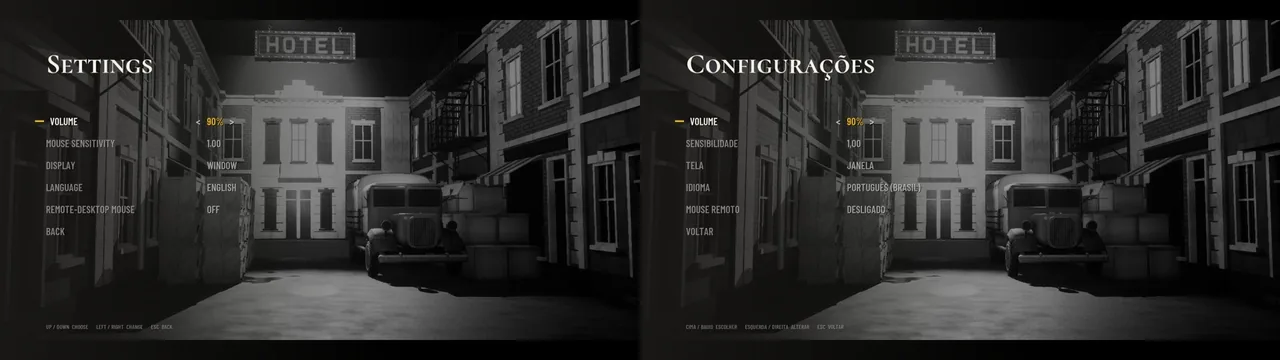
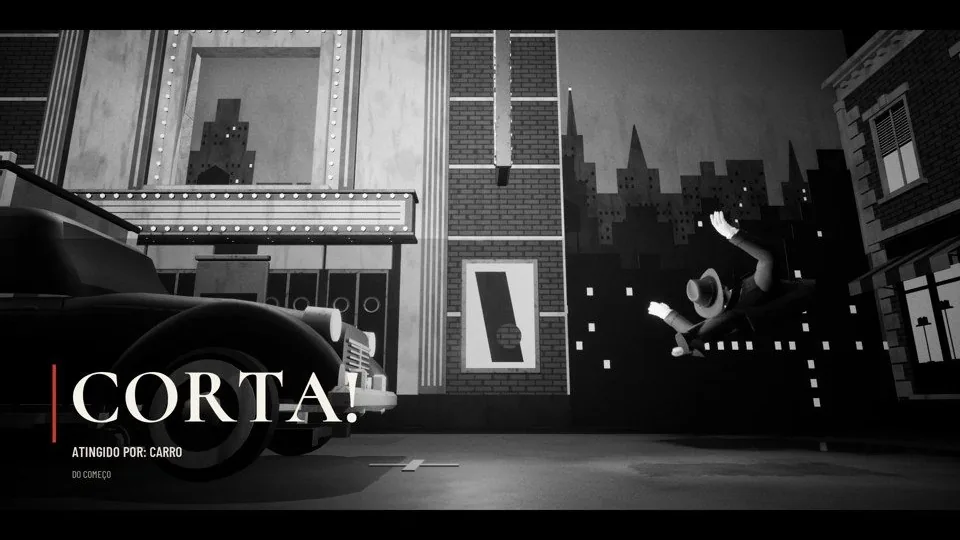
Scripted runs passed in both languages, including the menus, a full replay and a failure. One sample from the packaged build, a failure in Portuguese, passed too. The words themselves — tone, and whether a phrase reads naturally — are a native speaker's call, and whether Portuguese ships in the jam build hasn't been decided yet.
The run that slid#
The art agent had delivered three animations for the detective, made in Blender with Python scripts (the run started from the Unreal template's jog):
- a refined run;
- a reaction to being hit by the car, from the left and from the right;
- a vault.
The developer approved them by watching Blender videos, with a precise note: approval of the movement, not of gameplay.
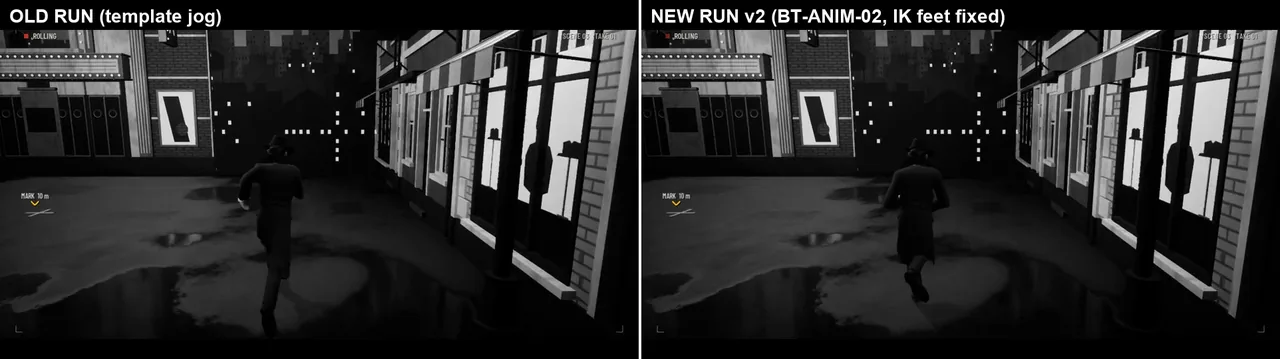
In the game, the run failed. With the new run in the locomotion blend, the planted foot kept travelling at more than 3 metres per second, where the template's run holds it to about 1. Locking the root didn't change anything. The new run was reverted, the old one stayed, and the problem went back to the art agent with the numbers. The vault was evaluated and not integrated.
This is the kind of thing only the engine can tell you. The clip looked right on its own; it slid once it was blended with everything else.
A fall that ends in mid-air#
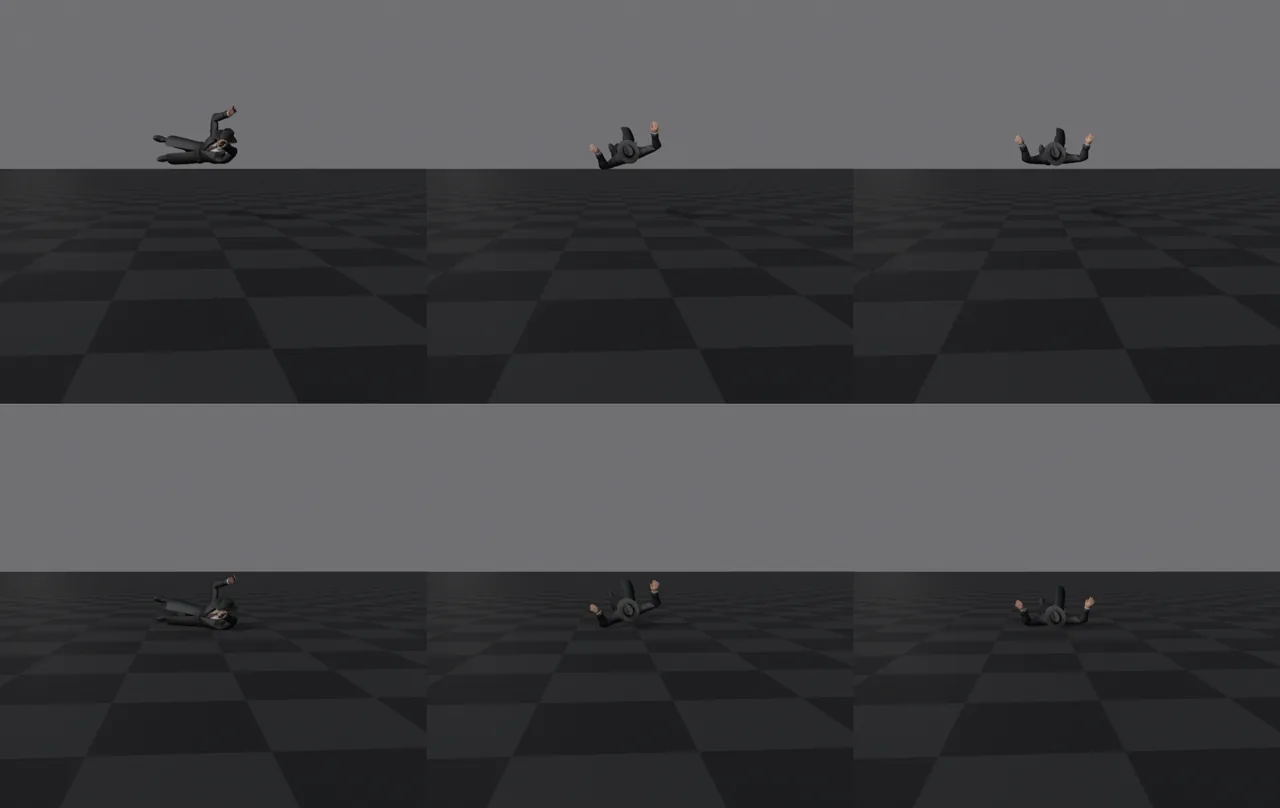
The car-hit reaction worked in the scripted runs. Then a small fix exposed a bigger problem. The failure card appeared after 0.9 s and cut the 1.4 s animation in half. Making the card wait for the end showed the final pose floating in the air, even with 3.5 seconds of waiting.
Measured on the clip: the pelvis ends at 108 cm, higher than when the detective is standing (86 cm). The car-hit reaction is now off by default, behind a switch for testing.
Later that evening, the art agent sent a fix: the run now cancels the root's movement every frame, and the fall ends with the pelvis at 12 cm. It has not been tested in Unreal. The agent itself wrote that the pelvis alone doesn't explain the sliding foot.
Small things a player notices#
From the developer's review of the 18:30 build:
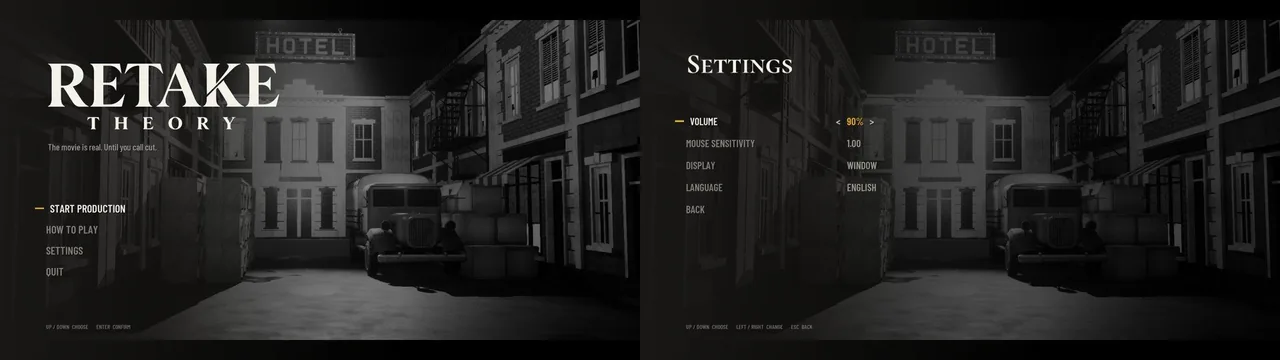
- the remote-desktop mouse option left SETTINGS;
- the volume arrows now work with the mouse — a scripted click test reads 100 → 90 → 100;
- the title screen got darker, with more contrast;
- the Portuguese failure card says CORTA!
A fourth scene? Research, evening of 13 November#
Update, 15 November: a fourth scene is now in the game, built from a later concept, not from the candidates below. Day 3 — The Impossible Take tells how. This part is left as it was written on 13 November.
Three scenes run from the first slate to the wrap. On the evening of 13 November the developer opened a question: could the game end on a fourth scene, bigger than the other three? This part is about the research, not about a level. There is no Scene 4 in the game: nothing has been built in Unreal, nothing has been played, and the concept itself is being reconsidered.
Research — Three candidates, scored#
Agent 04, the level-design reviewer, wrote three candidate concepts. It scored each one against the same criteria and wrote a design, a list of risks, a development brief and an asset brief for the highest-scoring one:
| Candidate | Score | Status |
|---|---|---|
| THE LONG TAKE | 24 | Proposal |
| ROUND THE BLOCK | 32.5 | Proposal, recommended by the agent |
| THE LEAP | 28 | Proposal |
Every document says the same thing at the top: proposed — nothing implemented, nothing tested. The agent didn't open the editor or run the game. The go/no-go questions it left for the developer have not been answered.
Research — Building only from what already exists#
In parallel, the art agent was asked not to make anything new. The developer's instruction: don't duplicate models that already exist. So the agent catalogued the pieces already in the game — 83 meshes — and assembled a test layout in Blender from 290 instances of them, without generative AI and without spending credits. The point was to see the scale and the look a larger set would have, using only parts the game already ships.
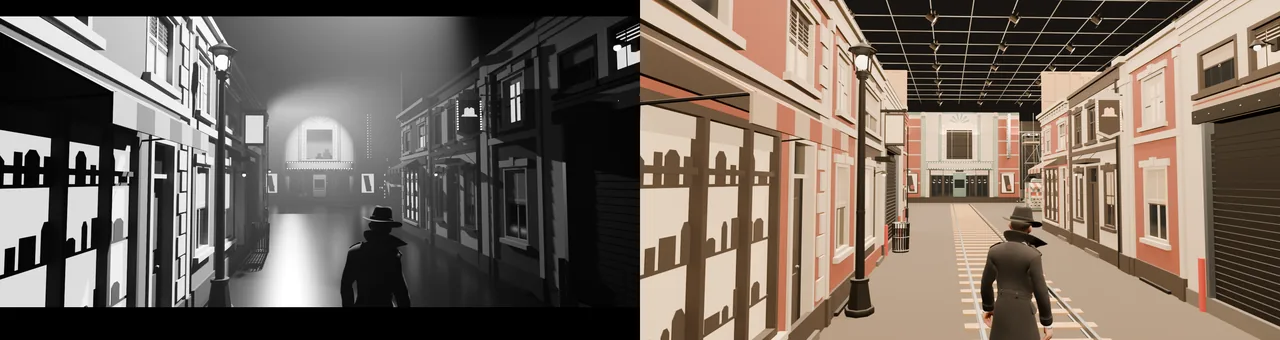
The next phase of that work is blocked until the concept is decided.
Next — Bigger, and more original#
Having read the candidates, the developer asked for a creative re-think: a final scene that is larger and more original than an extension of what the first three already do. So this part ends on an open question, on purpose. If a fourth scene makes it into the game, its own chapter will show how it was built and tested. If it doesn't, this page will say so.
Late night, 13 November#
At 20:00 the new run was reverted, the car hit was switched off and the original score was still outside the game (see above). Between 21:45 and 23:40, all three went in — and a fourth problem turned up as soon as the developer opened the build.
The run and the hit, second version#
The developer authorised an experimental integration of the art agent's corrected animations: try them in Unreal, measure them, and only then make them the default.
Two defects turned up, and both were fixed inside Unreal. The first only showed in the game:
- The feet. The new clips didn't animate two helper bones the template uses to plant the feet. In the game, the foot of the new run lifted only 3 cm and slid along the ground. A script added the missing tracks.
- The hit from the right started almost three metres to the side on its first frame. It was the mirror of the hit from the left plus a constant offset, and a script removed it.
Measured in the game, on Scene 3's street (speed of the planted foot, in cm/s, median; lower is better):
| Old run (template) | New run as delivered | New run, fixed | |
|---|---|---|---|
| Straight line | 91 | 638 | 70 |
| Zigzag | 95 | 630 | 117 |
| Right after CUT → ACTION | 113 | 624 | 96 |
| Highest point of the foot | 52 cm | 3 cm | 54 cm |
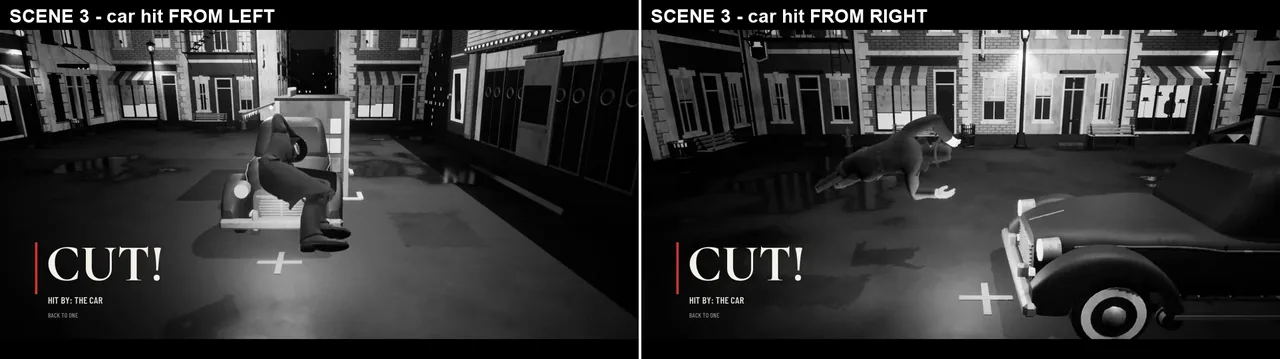
The car hit is back on by default. It now falls to the side the car is travelling, the actor turns up to 90° at the impact, and the camera follows the body — before, facing the car, the actor left the screen for 32 frames. Its lowest point now ends 3.8–5.0 cm above the ground, instead of in mid-air. Scripted runs checked every frame of the reaction for walls or the car between the camera and the body, and for the camera inside the body: none, in four directions on Scene 3 and in Scene 2.
The score in the game#
The original score the audio agent generated with ElevenLabs on Day 2 went in, at the developer's request:
- the menu theme, the action music, a sting for a printed shot and one for the wrap, on their own music bus;
- in CUT, the action music stops like tape, and it never plays in the studio;
- SETTINGS now has MASTER VOLUME, MUSIC and SOUND EFFECTS.
Scripted runs with sound counted every music start, print and wrap, one voice per role and zero music in CUT. A script can count voices; it can't tell how the music sounds. That was left to the developer — and the next playtest found a problem the counts had missed, which is where Day 3 begins.
A title screen without its scene#
Opening the new build, the developer noticed the title screen had no music and looked too bright. After a take and a return to the menu, everything was right.
The cause: the title opened on the very first frame and paused the world before the first scene's start timer could run. With the world paused, timers don't run, so the scene only started when the menu closed — and without a scene there was no sound profile and no scene lighting. The scripted runs never saw it, because they start the scene themselves, without the title.
Now the title waits for the first frame with an active scene. The repackaged build was checked: scene on frame 0, title on frame 1, menu music playing.
Not verified that night: whether the new run looks better, how the music and the volume settings sound, and the hit against walls in places the scripts don't reach. Nobody had played the new build yet.
The tools so far (Glass Box)#
As of the 13 November build. "In the build" means it is in the packaged game today; anything else is labelled.
| Tool | What for | In the build? |
|---|---|---|
| Claude Code 2.1.321 (Anthropic) | The code, the tests, the documents; the agents for art scripts, audio, localization, level-design review and this dev log | Yes |
| Unreal Engine 5.8.4 | The engine | Yes |
| Blender 5.2, by script | Props, sets, the world pack, the animations | Props and sets yes; run reverted; car-hit reaction off by default |
| Tripo AI | The detective's base model, generated by the developer, then cleaned up by the art agent | Yes — the actor's costume |
| PBRgen | One plywood texture set (18 credits) | Yes |
| ElevenLabs sound effects | 20 effects in the game; 9 more candidates | 20 yes; 9 not yet |
| ElevenLabs music | The score candidates (5,265 credits) | Not yet |
| ChatGPT | The RETAKE THEORY logo, made by the developer | Yes — main menu |
| Python (numpy), FFmpeg | Street textures; sound processing | Yes |
Which Claude models, from the session records:
- Claude Fable 5.2 and Claude Opus 5.5 for most of the work;
- Claude Sonnet 5.5 for part of the audio agent's sessions;
- Claude Haiku 5.5 in a handful of helper calls.